
How to Avoid Common Mistakes in Florida Property Tax Appeals
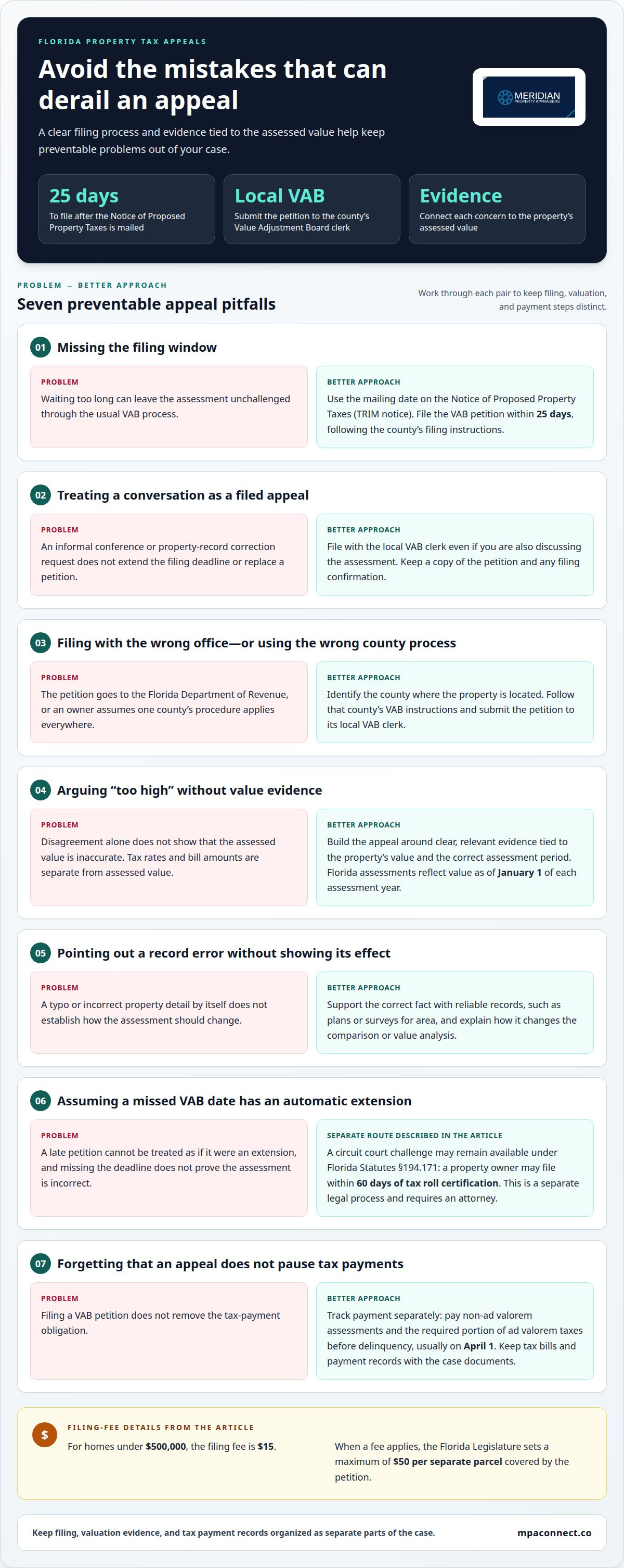
A strong case can still fail when the evidence doesn’t address the assessed value or a filing deadline is missed. The common mistakes in Florida property tax appeals often start with overlooking property-record errors, relying on poorly matched comparable sales, or treating an informal discussion as a substitute for filing a Value Adjustment Board petition. Property owners have 25 days from the mailing of the Notice of Proposed Property Taxes to file.
It’s understandable to focus on whether an assessment seems too high. But an effective appeal needs more than disagreement: it needs clear, relevant evidence tied to the property’s value and the correct assessment period.
This guide explains how to review assessment details, choose comparable sales, and organize evidence for residential or commercial disputes. You’ll learn why deadlines and procedure matter, how property condition or income information may support a case, and when a professional tax valuation appraisal can help strengthen your valuation evidence. A careful, documented approach makes it easier to present the issue clearly and avoid preventable mistakes.
Table of Contents
Why do so many property tax appeals fail?
Appeals can falter when owners miss filing dates, follow the wrong county procedure, or mistake an informal discussion for a filed petition. For homes under $500,000, the filing fee is $15. When a fee applies, the Florida Legislature sets a maximum of $50 per separate parcel covered by the petition.
Review County Appeal ProceduresStart by identifying the Florida county where the property is located, then follow its Value Adjustment Board (VAB) petition instructions. Submit petition forms to the local VAB clerk, not the Florida Department of Revenue. County procedures explain where and how to file. Keep those instructions with your petition, and don’t assume that one county’s process applies throughout Florida.
Find the Filing DeadlineRead the Notice of Proposed Property Taxes, commonly called the TRIM notice, and use its mailing date to calculate the appeal window. Florida property owners have 25 days from the mailing of the notice to file. Check the relevant county’s instructions for filing details. A property-record correction request or informal conference doesn’t extend the petition deadline.
File Before the DeadlineSubmit the VAB petition to the local clerk before the applicable deadline, even if you’re also discussing the assessment with the property appraiser. An informal conference may help resolve the dispute, but it doesn’t replace filing. Keep a copy of the petition and any filing confirmation. A late petition can leave the assessment unchallenged through the usual VAB process.
Address a Missed VAB DeadlineIf the VAB deadline has passed, consider whether a circuit court challenge remains available under Florida Statutes §194.171. A property owner may file a lawsuit within 60 days of tax roll certification, and this route requires an attorney. It is a separate legal process, not an automatic extension. Missing the VAB deadline doesn’t itself establish that the assessment is incorrect.
Track the tax payment requirement alongside the appeal. A VAB petitioner must pay non-ad valorem assessments and the required portion of ad valorem taxes before delinquency, usually on April 1. Filing a petition doesn’t remove this payment obligation. Keep the tax bill and payment records with the case documents, so payment and filing remain distinct steps.
Understanding assessment notice values and property details
Read the notice as a record of the property and its assessed value, not simply as a tax bill. An effective appeal connects a specific error or valuation concern to evidence about the property.
Read the Assessment NoticeStart by locating the assessed value, property description, classification, and any exemptions shown on the notice. Florida assessments reflect the property’s value as of January 1st each assessment year. An appeal generally focuses on whether the assessed value is accurate, while tax rates and bill amounts are separate issues. Separate those issues before deciding what evidence the filing needs.
Check Property RecordsCompare the listed details with reliable records, including building area, property type, unit count, age, condition, garage, and land dimensions. Square footage can refer to above-grade living area, gross building area, rentable area, basement area, or lot area. Don’t treat these measurements as interchangeable. Plans, surveys, permits, condominium declarations, or professionally prepared measurements can help establish the correct figure.
Review Exemptions and Assessment CapsIdentify whether the issue concerns assessed value or a denied exemption. A valuation appeal argues that the property’s assessed value is inaccurate; an exemption challenge concerns whether a tax benefit was denied. Florida’s homestead exemption removes the first $25,000 of assessed value from all property taxes, with an additional $25,000 applying to non-school taxes. Applications are due by March 1 of the tax year. Review any applicable Save Our Homes cap separately from the property’s market value.
Consider Possible Assessment ChangesBuild the appeal around evidence, not the assumption that an adjustment can only lower the assessment. A review may leave assessed value unchanged or adjust it upward or downward. The tax bill also reflects factors beyond assessed value, so a change to that figure doesn’t automatically produce the same change in the amount owed.
Organize exhibits around each claim. For a square-footage error, pair the correct measurement with a survey or plan. For a condition concern, use photographs and contractor repair estimates that document the issue as of January 1st. A typo alone doesn’t establish its effect on valuation; explain how the corrected fact changes the comparison or value analysis. Include relevant evidence with the initial filing when possible. A tax valuation appraisal can provide a structured valuation analysis for an assessment dispute.
How do I pick the right comparable sales?
Estimate a property’s market value as of January 1 by examining relevant sales from around that valuation date. Focus on properties with similar features and location, then explain why each sale helps assess the subject property.
Screen Comparable Sales for SuitabilityStart with 3-5 properties that sold for less than the assessed value, then test whether each is a fair comparison. Favor sales from the past twelve months, with sales from 6-12 months before the assessment offering useful context. In urban areas, nearby sales within about a half mile may be relevant. Older or distant sales can be weak evidence if local market conditions or property characteristics differ.Compare the subject home’s size, property type, age, condition, lot, and major features with each candidate. A property around 20 percent of the subject home’s square footage may be a closer match than a much larger or smaller one. Don’t choose a sale solely because its price supports a lower tax assessment. A mismatch can weaken otherwise useful comparable sales.
Use Comparable Sales EvidencePrepare a clear comparison for each selected sale. Show its sale date, location, price, square footage, and relevant features alongside the subject property’s corresponding details. Explain meaningful differences, such as a garage, lot size, or condition, instead of treating the properties as identical. A concise, organized comparison helps the reviewer see how each sale relates to the valuation you’re requesting.Use sales close to the assessment’s January 1 valuation date whenever possible. A sale from within the past year may help show market conditions, but timing alone doesn’t make it comparable. For example, a nearby house with substantially different size or condition may be less persuasive than a similar home farther away. State the reason for including each sale and how it supports the value presented.
Keep the evidence focused. Three well-matched sales can make a clearer case than a longer list of inconsistent properties. If a sale differs substantially in location, size, or property type, explain why or leave it out. For a condominium, compare similar units rather than detached houses. For a property with a larger lot, consider whether the selected sales reflect that feature.Connect the evidence to the requested adjustment. Summarize the range indicated by the selected sales and explain why those transactions better reflect the subject property’s value than the assessment. Don’t present a sale price as a direct substitute for assessed value. A strong comparison acknowledges its limits, uses relevant facts, and gives the reviewer a reasoned basis for considering the proposed valuation.
Evidence and documentation for an appeal
Build the appeal around evidence showing why the property is overvalued or its assessment details are wrong. Organized documentation helps connect each claim to the relevant valuation date. One of the common mistakes in Florida property tax appeals is gathering records without explaining what each one proves.
Gather Appeal DocumentationMatch each appeal point with evidence that addresses it directly. Recent comparable sales can support a valuation argument, while an expert appraisal can offer an independent analysis of the property. For an exemption or classification dispute, gather records showing the property’s use or eligibility. Avoid submitting an unsorted collection of documents. The reviewer should be able to tell which claim each exhibit supports.Prepare a simple index that identifies each item and its purpose. For example, label a survey as evidence of land dimensions, not general market value. Pair an appraisal with the property details and valuation conclusion it discusses. This organization helps distinguish evidence about the property itself from material describing nearby conditions or unrelated transactions.
Document Property Damage or DefectsRecord damage and deferred maintenance with dated photographs, repair estimates, and documents describing the affected area. Evidence should show the property’s condition as of January 1st, the relevant assessment date. A photograph of a roof leak may show visible damage, while a contractor estimate can describe necessary repairs. Connect each item to the condition being claimed.Don’t rely on photographs alone to establish the full effect of a defect. A picture may show a damaged room, but not the repair scope or the condition’s impact on value. Add a contractor estimate or another relevant record when available. Without supporting documentation, an appraiser or reviewer may lack a clear basis for evaluating the claimed condition.
Use an appraisal when the dispute needs a structured valuation analysis. A professional appraisal can provide relevant evidence in a Florida property tax appeal, particularly when it addresses the property and valuation at issue. Check whether the report explains its methods, property characteristics, and supporting market evidence. A common mistake in Florida property tax appeals is relying on a report that doesn’t address the disputed assessment point.Make the appraisal’s purpose clear. A report prepared for a different transaction or date may not answer the current assessment question. Explain which findings relate to the appeal and how they support the value you’re presenting. For a residential property, the report should describe relevant features and condition, not rely only on broad market statements.
Arrange exhibits in the same order as your appeal arguments. Put property-record evidence beside the claim it supports, followed by sales records or appraisals for valuation issues. Group photographs and repair estimates together for condition concerns. This sequence lets the reviewer follow your reasoning without searching through unrelated paperwork. Keep a complete copy of the submitted materials for reference during the hearing.Submit persuasive evidence with the initial filing when possible. Florida property owners bear the burden of proving that an assessed value is inaccurate, so simply saying the assessment seems high isn’t enough. For each requested adjustment, state the issue, identify the supporting document, and explain what it demonstrates. Avoiding common mistakes in Florida property tax appeals starts with clearly connecting each claim to its evidence.
Residential and commercial property tax disputes
Florida property tax disputes follow a shared process, but the evidence depends on the property and the claim. Residential owners often focus on comparable sales or condition, while income-producing properties may require a different valuation analysis.
Match the evidence to the property type. For a home, compare the assessment with sales of similar properties and document differences in size, condition, or features. For an income-producing property, income evidence may support an appeal when the assessor’s property record is accurate but the assessment still seems high. A residential sale alone may not explain an income-producing property’s value.Florida property owners may appeal each year if they believe an assessment is too high. Chapter 194 of the Florida Statutes governs assessment appeal procedures. The Florida Value Adjustment Board (VAB) is an independent board of local government officials that hears valuation disputes. Match the argument and exhibits to the actual issue, rather than filing a general objection to property taxes.
Separate valuation claims from classification or exemption claims. A homeowner disputing assessed value needs evidence about value. A property owner disputing classification can use leases, occupancy records, evidence of residential or business use, zoning, photographs, permits, or governing documents. These records help explain how the property is used and why its classification should be reviewed.At an informal conference, owners can bring documentation and ask the property appraiser to explain facts supporting the assessment or a denied exemption or classification. They can also petition the VAB, or pursue both options. A conference can clarify the disagreement, but a formal petition presents the dispute for VAB review. Keep each claim distinct so evidence for classification doesn’t obscure a valuation argument.
Prepare for a hearing around the central question. For a residence, organize comparable sales and records of condition. For an income-producing property, arrange relevant income evidence and explain how it relates to the valuation. If the case concerns classification, group occupancy, use, and governing documents. A focused presentation helps the reviewer follow your reasoning and assess each piece of evidence.Formal appeals do not all produce the same result. Between 30 and 60 percent of homeowners who formally appeal win some reduction, with results varying by jurisdiction. That range is not a forecast for an individual property. The practical takeaway is to present a specific claim, support it with relevant records, and address the property’s actual use and value.
Choose the review route that fits the dispute, then keep the record organized. The VAB hears valuation disputes, while an informal conference lets owners discuss supporting documentation with the property appraiser. For residential or income-producing properties, label evidence by issue and connect each document to the requested adjustment. Get help organizing a property valuation case when the dispute calls for a structured review of property-specific evidence.
Meridian Property Appraisers Inc.
Meridian Property Appraisers Inc. can help property owners develop clear valuation evidence when an assessment appears inaccurate. A Tax Valuation Appraisal provides a detailed analysis of the property’s value to support an appeal, while the owner remains responsible for filing through the appropriate county process. The appraisal should address the property and valuation question at issue, rather than rely on a general objection to the tax bill.
Consider professional valuation support when property details are complex, comparable sales are difficult to interpret, or the evidence needs a more structured presentation. Meridian Property Appraisers Inc. also provides appraisals for pre-listing, divorce, inherited property, and FEMA-related matters.
Contact Meridian Property Appraisers Inc. to discuss appraisal support for your property valuation needs.
Take the next step with a clear valuation question
Turn your concern into a specific valuation question before deciding how to proceed. Identify whether the central issue involves property details, market evidence, condition, or another appraisal need. This focus helps keep the next discussion practical and prevents common mistakes in Florida property tax appeals from becoming avoidable distractions.
Meridian Property Appraisers Inc. provides appraisals for property decisions, including Pre-Probate Inherited Properties Appraisal, Pre-Listing Appraisal, and Divorce Appraisal. For an assessment dispute, a Tax Valuation Appraisal provides a property-specific valuation analysis. An appraisal can support the evidence you present, while filing requirements and deadlines remain separate parts of the appeal process.
Before reaching out, gather the assessment information and records that relate to your valuation concern. A concise explanation of the issue gives the discussion a useful starting point. Contact Meridian Property Appraisers Inc. to discuss your appraisal needs and the property question you’re working through. With a clear focus and organized information, you can take the next step with greater confidence.
Frequently Asked Questions
Can a wrong classification support an appeal?
Yes. A classification dispute can support an appeal when records show the property’s actual use differs from the assessor’s classification. For example, leases, occupancy records, zoning documents, permits, photographs, or governing documents may clarify whether a property is used for residential or business purposes. Organize evidence around the specific classification issue and explain how the documented use relates to the classification being challenged.
Does incorrect square footage guarantee a lower assessment?
No. A square-footage error doesn’t automatically lower the assessed value. The appeal needs reliable evidence of the correct measurement and an explanation of how the difference affects valuation or comparison with similar properties. For example, a corrected measurement may matter if it changes the property’s size relative to comparable sales. A typo without a demonstrated valuation effect may not establish that the assessment is inaccurate.
How can you check whether the square footage is wrong?
Compare the property record’s measurement with documents such as architectural plans, surveys, permits, builder records, condominium declarations, or professionally prepared measurements. First identify what area the record describes: above-grade living area, gross building area, rentable area, basement area, or lot area. These figures measure different things. Photographs may show layout or condition, but usually don’t establish exact square footage on their own.
How do I prepare for the appeal hearing itself?
Prepare a concise presentation that connects each claim to an exhibit. Arrange documents in the order you plan to discuss them, label what each supports, and keep the requested adjustment clear. Florida VAB hearings typically take 15-30 minutes, so prioritize the strongest evidence rather than reading every record aloud. Be ready to explain why each document relates to the property and valuation date at issue.
How do county procedures differ?
Counties administer local filing details, so forms, submission instructions, and clerk procedures can differ. Start with the county identified on the property’s assessment notice, then follow its VAB petition instructions. This matters for property owners in Tampa, Saint Petersburg, Orlando, Jacksonville, Clearwater, Largo, Pinellas Park, Seminole, Miami, and Fort Lauderdale, where the parcel’s county determines the local filing process.
Should I accept the informal review offer from the assessor?
Compare the offer with your documented target value and read its terms before accepting. An offer within 10 to 15 percent of your target may merit consideration if accepting it doesn’t waive further appeal rights. Focus on the proposed assessment adjustment and any stated effect on continuing the appeal. An informal discussion or offer should not be treated as an extension of the petition deadline.
What is the deadline to appeal a Florida property tax assessment?
File within 25 days from the mailing of the Notice of Proposed Property Taxes. Use the mailing date on the TRIM notice to track the filing window, and follow the instructions for the county where the property is located. An informal conference with the property appraiser doesn’t extend the VAB petition deadline, so keep the filing date separate from any ongoing discussion.
How do Florida property tax appeals work with the county value adjustment board (VAB)?
A property owner may petition the county VAB to review an assessment dispute. Submit the petition to the local VAB clerk and organize evidence around the specific value, classification, or exemption issue. The VAB hears valuation disputes through a local review process, and its magistrate’s decision is mailed within 20 days after the hearing. Keep copies of the petition and exhibits together for reference.



Comments