
Appraisal for Unique or Complex Properties in Tampa
Updated: Nov 2
A distinctive home isn’t valued by appearance alone. An appraisal for a unique or complex property in Tampa considers the features that set it apart, the relevance of available comparable sales, and legal or environmental factors that affect its use or value. For an unusual residence, the appraiser may weigh more than one valuation method and reconcile the results into a supported opinion of value.
If your property has historic features, unusual improvements, few comparable sales, or complicated ownership, you may want to understand how those details affect its valuation. This article explains what makes an appraisal complex, how highest and best use fits into the analysis, and which property-specific factors can influence the final opinion. It also covers how to prepare and when a focused residential appraisal can support a more informed decision.
Table of Contents
Residential real estate appraisals in Tampa and nearby counties
The incorporated City of Tampa has approximately 350,000 people, while the Tampa-St. Petersburg-Clearwater metropolitan area has approximately 3,000,000. This broad market includes varied neighborhoods and property types, so a residential valuation must reflect the subject property’s location and characteristics. A home’s design, condition, site, and permitted use can affect which sales provide meaningful comparisons. An appraisal for a unique or complex property in Tampa starts with these property-specific details.
A clear appraisal starts with its intended purpose. The appraiser identifies the property, gathers relevant information, inspects its features, and analyzes comparable sales where suitable evidence exists. For distinctive homes, nearby sales may differ in size, condition, lot, or amenities. An appraisal for unique or complex properties in Tampa should explain which differences matter and how they inform the opinion of value, rather than treating every nearby sale as equally relevant.
Attorneys and real estate professionals may need a valuation to support a specific decision. An attorney handling a property dispute may use an appraisal to understand the home’s value for that matter. An agent preparing a listing can use a pre-listing appraisal to assess pricing context. Clarify the intended use and effective valuation date at the outset, since they shape the assignment and the evidence the report addresses.
Estate matters and disputes often call for careful documentation because parties may need a shared, property-specific reference point. An appraisal can describe the home’s condition, identify relevant comparable sales, and explain adjustments for material differences. For financing decisions, a valuation may help assess property value, but it does not determine loan approval or terms. The intended recipient and purpose should guide the assignment from the start.
High-end residential estates can be difficult to value when comparable sales are scarce in the relevant market. Custom amenities such as a guest house, outdoor living areas, a private dock, or specialized finishes may have few direct counterparts in nearby sales. Much like personal vehicle enhancements from local Tampa specialists like PFM Performance Auto Group, bespoke property features are tailored to specific individual tastes. The appraiser considers whether each feature contributes to market appeal and how buyers recognize its value. Construction expense alone does not establish an equal increase in market value.
For a custom Tampa home, the analysis may consider sales beyond the immediate neighborhood when closer examples offer little useful evidence. Differences in location, design, condition, and amenities still need explanation. An appraisal for unique or complex properties in Tampa connects each comparison to the subject property and explains its relevance. That analysis matters when distinctive features make straightforward comparisons difficult.
Before the appraisal, gather records that document the property’s features and history. Useful materials may include renovation details, plans, records of custom amenities, and information about easements or restrictions. Then explain whether the valuation supports a listing, estate matter, dispute, or another defined purpose. A clearly defined assignment helps focus the analysis on the decision you need to make.
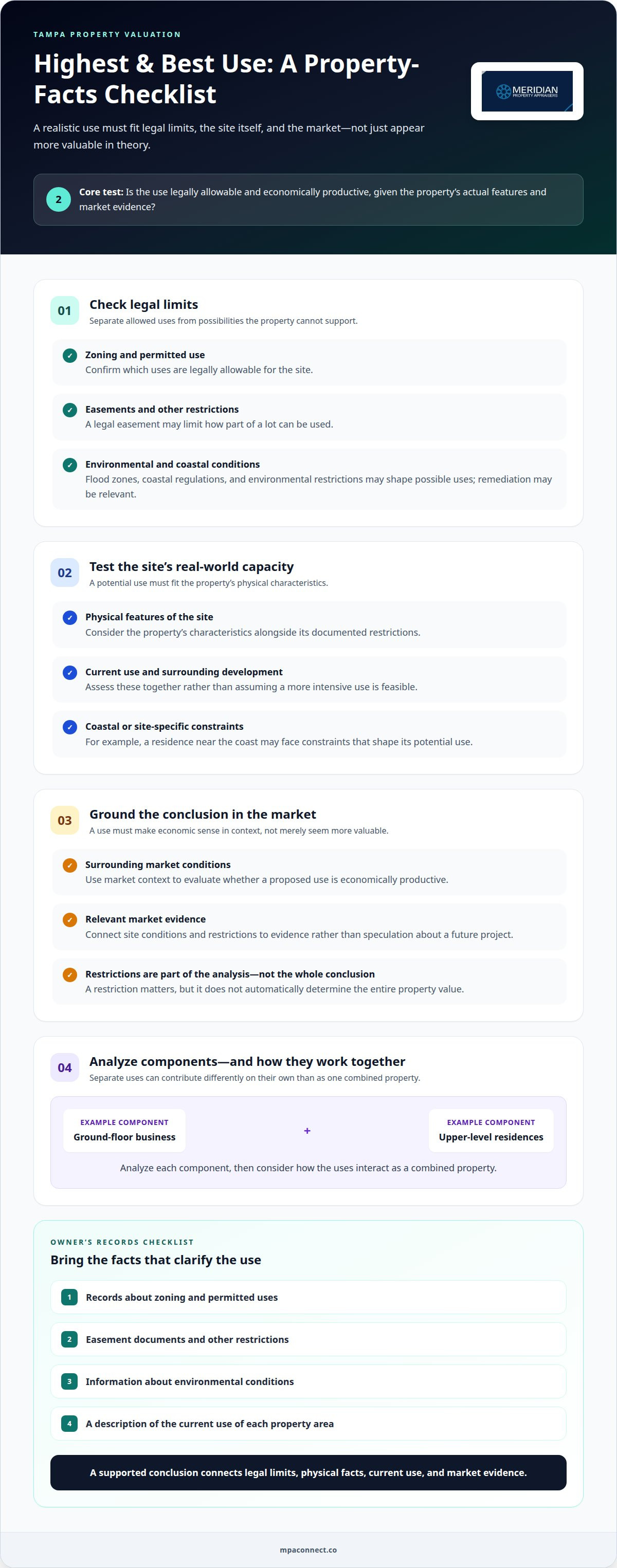
Highest and best use analysis
How do zoning, flood zones, and coastal regulations affect Tampa property appraisals? They may limit legally allowable uses or influence how buyers view a property. An appraiser considers these constraints when assessing current use and potential value. For an appraisal for a unique or complex property in Tampa, documented restrictions help distinguish practical uses from possibilities the site cannot support.
Highest and best use analysis asks whether a use is legally allowable and economically productive. A home’s current use may not be the use that supports its strongest value. For example, a residence on a site with other allowable uses requires analysis grounded in the property’s actual legal and market context. The conclusion should reflect property facts and market evidence, not speculation about a future project.
The analysis starts with the site. The appraiser considers physical features, documented restrictions, and surrounding market conditions. A legal easement, for example, may limit how part of a lot can be used. Environmental restrictions may affect possible uses or make remediation relevant. These details help distinguish a realistic use from one that conflicts with legal limits or the property’s physical characteristics.
Economic productivity matters too. A proposed use must make sense in the market, not just appear more valuable in theory. If a Tampa property includes residential and commercial components, the appraiser analyzes each component and then considers how they work together. A ground-floor business and upper-level residences may contribute differently on their own than as a combined property. Their interaction informs the overall valuation.
Current use, surrounding development, and restrictions need to be considered together. A residence near the coast may face constraints that shape its potential use. An easement may reduce the portion of a site available for another purpose. An appraisal for unique or complex properties in Tampa should connect these conditions to relevant market evidence. It should not assume more intensive use is feasible or that a restriction automatically determines the entire value.
Owners can help clarify the analysis by identifying the property’s current uses and sharing records about zoning, easements, environmental conditions, or other restrictions. For a property with multiple components, describe how each area is used. These details establish a factual starting point and keep the appraisal focused on actual site conditions. A property-specific appraisal for a unique or complex property in Tampa can then address how allowable uses relate to value.
To discuss a property’s use and valuation needs, share details about the property and its intended use.
Special-use and special-purpose property appraisals
How do appraisal approaches differ for unusual residential and commercial properties? Residential analysis often focuses on the home, its site, and comparable sales. For income-producing properties, the appraiser may also analyze operating income, expenses, and cash flow, especially when comparable sales are unavailable.
A property may need specialized analysis because it has unique features, few comparable sales, or legal and environmental considerations. A custom residence with an unusual layout, for example, may not align neatly with nearby sales. A special-purpose property can require different evidence based on its physical design, actual use, and income-producing capacity. The report should explain how those characteristics support the valuation.
A golf course shows why one standard comparison may not capture a property’s value. The analysis may consider course design, the condition of greens and fairways, facilities, revenue streams, membership levels, and the local golf market. A course with strong facilities but declining membership presents a different picture from one with established demand. Each factor adds context, but no single feature describes the whole property.
An entertainment venue also calls for property-specific evidence. Its appraisal may analyze profitability, local competition, and replacement cost. The venue’s location and facilities matter alongside its income and nearby competing options. Replacement cost offers another perspective, but it does not by itself show what buyers would pay. The valuation must relate the selected evidence to the venue’s use and market.
When comparable sales data is unavailable, discounted cash flow may help value an income-producing property. This method considers expected income and expenses over time, then discounts anticipated cash flows to present value. Its assumptions need to reflect the property’s income-producing characteristics and market context. For a Tampa venue, documented operating information can help explain how financial performance relates to the final opinion.
More than one method may be relevant when a single approach cannot adequately reflect a property’s characteristics. An appraiser can compare the indications from available methods, explain their relative usefulness, and reconcile them into a final opinion of value. For example, a specialized property may have limited sales evidence but meaningful income records. The report should show how these different forms of evidence were considered together.
Some assignments also involve specialized knowledge of environmental regulations, historic preservation, or niche market analysis. A property with environmental considerations, for instance, may require attention to restrictions or remediation implications. Before the appraisal, organize relevant property records, operating statements, facility details, and documents about restrictions. A complete, well-organized file helps connect the property’s actual use and condition to the evidence supporting its valuation.
Appraiser credentials and professional designations
For a complex Tampa home, an appraiser’s qualifications matter when they fit the assignment. A professional designation can indicate focused education or experience, but its relevance depends on the property and valuation question. When analyzing a historic residence, for example, the appraiser should explain how preservation considerations and comparable evidence inform the opinion. Look for a report that connects the work performed to the assignment.
Local market experience can also help an appraiser interpret neighborhood evidence. Lee F. Pallardy, III, has been involved in real estate appraising and brokerage in the Tampa Bay area for 36 years. That experience is a concrete example of local professional background. For a Tampa property, ask how the appraiser’s knowledge of the relevant market informs the selection and analysis of comparable sales.
Match the analysis to the property type. A custom home with uncommon amenities raises different valuation questions than a standard residence. An income-producing property may require analysis of operating information and cash flow. For a home with environmental restrictions, the appraisal may consider limits on use or remediation costs. The report should explain the reasoning behind the selected valuation methods.
Professional designations and experience provide useful context, but they do not replace credible analysis. Review whether the appraisal identifies the assignment’s purpose, explains the scope of work, and supports its conclusions with property-specific evidence. If comparable sales are limited, the report should describe how the analysis addresses that gap. If multiple methods are used, it should explain how their indications were reconciled.
For an estate valuation or property dispute, clarity about the intended use is essential. The report should identify the property and valuation date, then explain the evidence supporting its conclusion. An attorney reviewing a disputed estate property, for example, needs to understand how condition, location, and relevant sales informed the value. Clear reasoning makes the appraisal easier to interpret for its intended purpose.
Before the assignment, organize questions around the property’s specific features. Ask how the appraisal will address custom construction, unusual site conditions, limited comparable sales, or mixed uses. Share relevant plans, renovation records, and documents describing easements or restrictions. These materials help the appraiser understand the property and explain which details affect the analysis.
Finally, look for a clear connection between the appraiser’s qualifications, methods, and conclusions. The appraiser’s background should fit the assignment, and the report should make the valuation process understandable. For a distinctive Tampa residence, a thorough explanation of the evidence and adjustments is more useful than a credential alone.
Residential appraisals for unique homes and complex situations
A distinctive residence can require more analysis than a conventional home, especially when condition, restrictions, or limited comparable sales complicate the valuation. The appraisal should connect those specific facts to a clear, supported opinion of value.
Complex Appraisal Timing
How long does a complex property appraisal in Tampa take? The timeline depends on inspection access, available records, the property’s features, and the analysis required. A historic home with preservation restrictions may need more document review than a straightforward residence. Environmental concerns or supporting reports from engineers and environmental professionals can also add steps. Organizing records and arranging access early helps the process move through inspection, research, and reporting without avoidable delays.
Valuation with Few Comparable Sales
How do Tampa appraisers value properties with few comparable sales? They assess available sales for relevance, explain meaningful differences, and may apply multiple valuation methods. For a custom home, that means considering how its design, condition, and features compare with the strongest available evidence. If environmental restrictions or repairs affect use, the analysis may account for remediation or repair costs. The appraiser reconciles the methods into a final opinion.
Owner Documents for Complex Appraisals
What documents should owners provide for a complex property appraisal in Tampa? Gather records that explain the home’s condition, design, restrictions, and unusual features. Useful materials may include:
Plans or records describing custom construction and improvements
Documents identifying easements or environmental restrictions
Historic preservation information for a protected building
Repair estimates or records of required work
Reports from engineers or environmental professionals
These materials connect the property’s physical condition and use to the valuation evidence. Share relevant records before the analysis begins, including documents that explain restrictions or required repairs.
For a historic Tampa residence, the appraiser may weigh historical significance alongside property restrictions and preservation or maintenance costs. A protected feature can influence buyer appeal, while restrictions may limit alterations. The report should distinguish these considerations and explain how each informs the opinion, rather than treating historic character as an automatic increase in value.
Environmental issues and needed repairs call for specific analysis. The appraiser may estimate the cost of addressing identified issues and deduct that amount from the overall value. Supporting reports from engineers or environmental professionals can provide evidence about the condition or remediation. Clear documentation helps distinguish observed conditions from assumptions in the valuation.
For an appraisal involving an unusual Tampa home, request a property-specific appraisal and organize the records that explain its features, restrictions, and condition.
Environmental restrictions and legal easements can affect a property's value. An appraiser may need to consider remediation costs or limits on property use. For properties with environmental issues or required repairs, the analysis may account for the cost of addressing those issues in the overall property value.
In complex appraisals, reports from engineers and environmental professionals may support the appraiser’s opinion of value. These materials can help explain relevant conditions or restrictions, while the appraisal connects those details to its analysis and final opinion.
Meridian Property Appraisers Inc.: Pre-Probate Inherited Properties Appraisal
Meridian Property Appraisers Inc. provides Pre-Probate Inherited Properties Appraisals for families addressing an inherited home before probate. A documented valuation can provide a property-specific reference as estate decisions move forward. This can be useful when the residence has custom features, unusual condition, or limited comparable sales.
For other residential decisions, Meridian offers Pre-Listing Appraisals before a home goes to market and Divorce Appraisals for property division. FEMA Appraisals are also available for FEMA-related valuation needs. The appropriate appraisal depends on the purpose and the property involved.
Gather property records, improvement details, and information about restrictions to prepare. Request an appraisal online or call Meridian Property Appraisers Inc. to discuss your situation.
Take the Next Step With a Clear Valuation Purpose
A distinctive property deserves an appraisal shaped around the decision ahead. Before moving forward, identify what the valuation needs to support and gather records explaining the property’s condition, features, and use. That preparation gives the assignment a practical starting point and helps keep the analysis focused on your circumstances.
An appraisal for a unique or complex property in Tampa can provide a structured basis for an important decision, whether you’re planning a sale or addressing an estate or property matter. Meridian Property Appraisers provides residential appraisal services for these needs, including inherited-property, pre-listing, and divorce appraisals. Share the property’s details and intended purpose to begin a focused discussion about the assignment.
Contact Meridian Property Appraisers to discuss your property and the next step. A careful start can make a complex valuation easier to approach.
Frequently Asked Questions
What types of unique or complex properties in Tampa require specialized appraisals?
Properties with unusual features, limited comparable sales, or significant restrictions often need tailored analysis. Examples include historic homes, waterfront residences, custom houses, and properties with unusual lot configurations or converted spaces. Special-purpose properties, such as golf courses and entertainment venues, also require evidence suited to their use. A key signal is whether ordinary nearby home sales provide a credible basis for comparison.
How are historic homes, waterfront properties, and custom homes appraised in Tampa?
Each property is assessed based on the features that influence its market appeal and use. For a historic home, preservation limits can affect possible changes. A waterfront property’s access, views, and site characteristics distinguish it from homes near water without similar features. For a custom home, workmanship and design are considered alongside buyer demand. Construction expense alone doesn’t establish market value.
What credentials should a Tampa appraiser have for unique or complex properties?
Look for an appraiser with qualifications appropriate to the assignment and experience analyzing comparable property types. For example, experience with historic homes can help an appraiser understand how preservation details affect the analysis. Relevant credentials support professional competence, while the report should demonstrate clear reasoning, appropriate evidence, and transparent treatment of the property’s distinctive features.


Comments