
Estate Appraisal Costs in Fort Lauderdale
An estate appraisal is most useful when its value reflects the property’s details and the purpose of the settlement. The cost of an estate appraisal Fort Lauderdale depends on factors such as property type, size, condition, and report scope. Meridian Property Appraisers Inc. provides a fee estimate after you request a quote, based on the property and assignment details.
Settling an estate can involve difficult decisions. A clear valuation gives heirs and other parties a practical basis for understanding a home’s worth. A residential appraisal may document value for estate planning or settlement, but the assignment should match the property and the report’s intended use.
This guide explains what residential appraisal fees may cover, when an estate appraisal can help, and what information to share when requesting an estimate. It also outlines the property and assignment details that can shape the work, so you can approach the next step with a clearer idea of what to expect.
Table of Contents
Reported residential appraisal price ranges
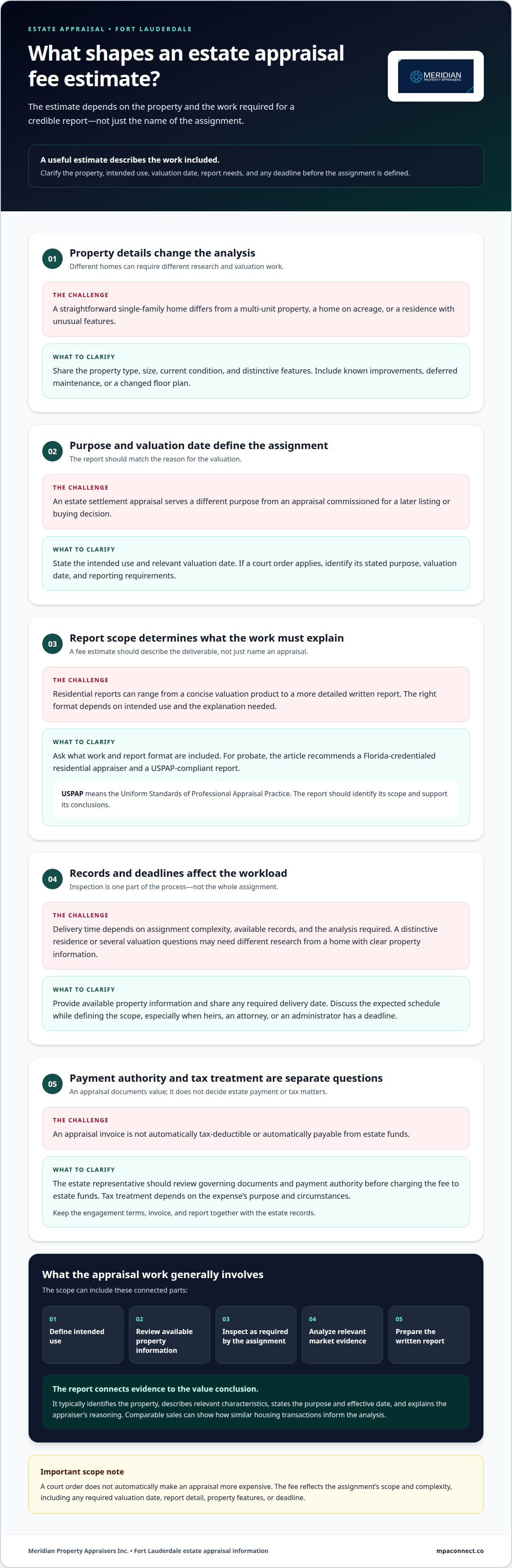
Residential appraisal costs depend on the property and the work required for a credible report. For an estate home in Fort Lauderdale, the assignment’s purpose, property type, size, condition, and complexity help define the scope. A straightforward single-family home differs from a multi-unit property, a home on acreage, or a residence with unusual features. These differences matter because the appraiser analyzes relevant housing data and explains how it supports the opinion of value.
A fee estimate should describe the work included, not just name an appraisal. The process generally involves defining the intended use, reviewing available property information, inspecting the home as required by the assignment, analyzing market evidence, and preparing the written report. An estate assignment may also require a valuation date tied to a specific point in time. Clarifying that date and the report’s intended use helps define the scope before work begins.
The appraisal report explains the analysis behind the value conclusion. It typically identifies the property, describes relevant characteristics, states the appraisal’s purpose and effective date, and presents the appraiser’s reasoning. Comparable sales can show how similar housing transactions inform the analysis. The report should connect its evidence to the conclusion, rather than state a value without explanation. Differences in condition or property features, for example, can affect how comparable sales are considered.
Delivery time after inspection depends on the assignment’s complexity, the availability of relevant records, and the analysis required. A home with clear property information may involve a different research workload from a distinctive residence or an estate with several valuation questions. The inspection is one step, not the whole process. Discuss the expected delivery schedule when defining the scope, especially if heirs, an attorney, or an administrator needs the appraisal by a particular date.
Residential reports can take different forms, from a concise valuation product to a more detailed written report. The right format depends on the intended use and the level of explanation needed. For probate, choose an appraiser with a Florida credential appropriate to residential valuation and request a USPAP-compliant report. USPAP means the Uniform Standards of Professional Appraisal Practice. The report should identify its scope and support its conclusions.
When choosing an estate appraiser in Fort Lauderdale, look for residential valuation experience and familiarity with estate assignments. Share the property address, property type, intended use, relevant valuation date, and any deadline. These details help define the scope and determine which report format fits the estate’s needs.
Estate settlement appraisals
An estate appraisal can give heirs a shared real estate value to inform decisions about a family home. Its role is to document value for a defined purpose, not to decide how owners divide property or handle estate funds.
Estate Appraisal Fee Responsibility
An appraisal invoice isn’t automatically tax-deductible or automatically payable from estate funds. These are separate questions: who authorizes payment, and how the expense is treated for tax purposes. The estate’s representative should review the governing documents and payment authority before charging the fee to estate funds. Tax treatment depends on the expense’s purpose and circumstances.
An appraisal used to inform an estate settlement, for example, serves a different purpose from one commissioned for a later listing or buying decision. Keep the engagement terms, invoice, and report together so the estate’s records show what work was completed and why. The appraiser documents the valuation; the estate representative handles payment authorization, and tax advice should account for the estate’s specific situation.
Court-Ordered Probate Appraisal Costs
A court order doesn’t automatically make a probate appraisal more expensive in Fort Lauderdale. The fee reflects the assignment’s scope and complexity, including any required valuation date, report detail, property features, or deadline. Valuing a straightforward family home may involve different work from assessing a property with extensive improvements or several questions the report must address.
Read the order carefully for its stated purpose, valuation date, and reporting requirements. Provide those details when defining the appraisal assignment. Identify any deadline or required format at the outset, since extra research or a more involved report can change the work. The order sets the assignment context, while the appraiser’s scope explains the analysis and deliverable.
Estate appraisals can support practical decisions beyond distributing property. Heirs may use a documented value when considering whether to retain, sell, or transfer a home. If one heir plans to buy out another’s interest, an appraisal can provide a shared valuation reference for discussion. It doesn’t set the final agreement between heirs, but it can clarify the property’s value.
Improvements and condition matter to the valuation analysis. A recently updated kitchen, deferred maintenance, or a changed floor plan may affect how the property compares with relevant sales. Share known renovation details and the home’s current condition as part of the assignment information. This context helps the appraiser analyze the real estate as it exists on the relevant valuation date.
Before commissioning work, align the estate representative and other decision-makers on the intended use, valuation date, and who can authorize the assignment. A clear scope helps distinguish an estate settlement appraisal from one prepared for another purpose, such as a future listing. Keep the order, engagement details, and final report with the estate records.
Information to provide when requesting an appraisal
A useful estimate starts with the assignment’s purpose and the property’s identifying details. Provide the Fort Lauderdale address, property type, and intended use of the valuation. An estate settlement, a planned listing, and another real estate decision can require different reporting. Clear information helps define the appraisal’s scope before analysis begins.
Include the valuation date if the estate needs a value as of a particular point in time. That date may differ from the inspection date or the day you request an appraisal. Share any court or estate instructions that specify the report’s intended use, format, or deadline. These details help determine the work required and the conclusions the report must support.
Gather available property records, such as a recent tax record, survey, floor plan, or prior appraisal. These materials can help identify the home’s features and clarify its layout, but they don’t replace the appraiser’s independent analysis. If records describe an older configuration, mention known changes so the property information can be considered accurately.
Property type: Identify whether the assignment concerns a single-family home, condominium, or another residential property type.
Improvements: Describe additions, renovations, or major repairs, and provide dates or records when available.
Condition: Note known maintenance concerns, damage, or incomplete work that could influence the valuation analysis.
Access: Explain how the appraiser can enter the property and whether any areas have restricted access.
Assignment details: Share the intended use, valuation date, required format, and any deadline.
Specific examples make property details more useful. “Kitchen remodeled” gives less context than “kitchen cabinets and counters replaced,” if that description is accurate. A converted garage, enclosed patio, or added room may affect how the appraiser understands the home’s layout. Describe what changed without assuming an improvement determines value on its own.
When requesting an estimate for a property with several buildings, unusual features, or extensive improvements, identify each feature. A home with a detached guest space, for example, needs a clearer description than one with a standard floor plan. Property complexity can influence the research and reporting scope, so complete details help the appraiser assess the work involved.
Name the person coordinating access and estate communication, and provide the best way to reach them. If an attorney or personal representative is directing the assignment, identify that role and share the relevant instructions. A complete initial request lets the appraiser clarify the scope, determine the appropriate report, and provide an estimate based on the assignment rather than incomplete property details.
Cost estimate disclaimer
A market figure is a reference point, not a quote for a specific estate property. A market snapshot for a standard single-family home or condo appraisal places the typical range between $272 and $375, with a median about $325. That band summarizes market offers, not the fee for a particular assignment or the value of the home. Property type, condition, complexity, and reporting scope all influence the work required.
The appraisal price depends on the assignment, and Meridian Property Appraisers provides an estimate after a quote request. Property type, condition, complexity, and scope help determine the fee. A standard residence and a home with unusual features can require different research and analysis. Share the intended use, valuation date, property details, and requested report so the estimate reflects the work involved.
Market ranges need careful interpretation. The band above refers to a standard single-family home or condo appraisal, not every residential assignment. It shouldn’t be applied automatically to a multi-unit property, a home on acreage, or a property with distinctive features. An appraisal fee also isn’t calculated as a percentage of property value. The work, rather than the home’s sale price alone, shapes the estimate.
Keep appraisal costs separate from other transaction expenses. Buyers may encounter appraisals connected with a purchase, while lenders may require one for their own lending decision. An estate settlement has a different purpose: documenting value for the estate’s needs. A buyer’s transaction, a lender’s requirements, and an estate’s reporting scope aren’t interchangeable, even when they involve the same property.
Before accepting an estimate, review what it covers. Confirm the property address and type, intended use, and valuation date, and make sure the deliverable fits the estate’s needs. A request for a historical valuation date, for example, may require analysis beyond a current-date assignment. A deadline or special report requirement can also affect the scope. Clear terms help prevent a mismatch between the requested work and final report.
Market reference: Use the $272 to $375 range and approximately $325 median only as a market snapshot for a standard home or condo appraisal.
Assignment scope: Match the estimate to property details, intended use, valuation date, and report requirements.
Cost comparison: Don’t treat a lender’s purchase appraisal or a buyer’s transaction as the same assignment as estate valuation.
A written estimate is most useful when it names the property, purpose, valuation date, and included report. If those details change, such as when a new reporting requirement is added, the work may change too. Keep the estimate with the estate’s records so the representative can compare the agreed scope with the completed appraisal report.
What is the average hourly rate for a probate appraiser in Broward County?
A single average hourly rate isn’t a reliable way to budget for probate appraisal work in Broward County. The time required depends on the property and assignment, and an estimate should reflect the full scope, not just inspection hours. For a Fort Lauderdale estate, consider the valuation date, property complexity, research, and report requirements together.
An appraisal involves more than a visit to the property. The appraiser must understand the assignment, analyze relevant market evidence, and prepare a report that supports the value conclusion. A simple property with clear records may need a different level of analysis from a home with unusual features, extensive improvements, or limited documentation. Each factor can affect the time devoted to research and reporting.
Hourly figures can be difficult to compare when they cover different tasks. One estimate might include inspection and analysis, while another describes only part of the assignment. Ask what work the estimate includes, what report it delivers, and whether it covers the requested valuation date. These details make it easier to compare proposals on the same basis.
A probate assignment may require a retrospective valuation, meaning an opinion of value for a past date. This can involve reviewing historical property information and market evidence relevant to that date, rather than relying only on present-day conditions. A current inspection alone doesn’t answer a question about an earlier valuation date. The requested date and purpose shape the analysis.
Property type matters, too. A condominium, single-family residence, and multi-unit property can involve different records and comparable sales. A home with a detached structure or substantial improvements may require additional analysis. Sharing those details early helps the appraiser define the work and explain the basis for the estimate.
To assess a probate appraisal estimate, focus on these points:
Assignment purpose: Identify how the estate will use the valuation.
Effective date: State the date the opinion of value must address.
Property details: Describe the property type, condition, and notable improvements.
Deliverable: Clarify the report format and required level of explanation.
Included work: Understand whether research, inspection, and report preparation are covered.
This approach answers the hourly-rate question more usefully than relying on an unsupported average. The relevant comparison is the scope and deliverable for the specific estate property. For a tailored estimate, request a probate appraisal estimate and provide the assignment purpose, valuation date, and property details.
Meridian Property Appraisers
Meridian Property Appraisers provides residential appraisals for property owners and estate representatives, with the assignment’s purpose and scope clearly defined. For inherited property, a Pre-Probate Inherited Properties Appraisal can support valuation planning before probate proceedings. The firm also provides appraisals for other residential needs, including pre-listing, divorce, and FEMA assignments.
To request an estate appraisal estimate, share the property address, type, intended use, relevant valuation date, and any report deadline. These details help clarify the work required and the report suited to your situation. An appraisal documents a property’s value; decisions about estate administration remain with the responsible parties.
If you need a residential appraisal for an estate matter in Fort Lauderdale, contact Meridian Property Appraisers to discuss the assignment.
Move Forward With a Clear Appraisal Plan
Estate decisions can feel more manageable when the valuation assignment has a clear purpose. Before moving forward, consider what the appraisal needs to help resolve: documenting value for estate administration, preparing for a future listing, or supporting a discussion among heirs. That purpose guides the work and keeps the report relevant to the decision ahead.
Understanding the cost of an estate appraisal in Fort Lauderdale starts with a clearly defined assignment, not a general market figure. Share the estate’s intended use and any requirements that will shape the report. Meridian Property Appraisers provides residential valuations for inherited property, listing preparation, and divorce. A focused conversation can clarify the right next step for your circumstances.
When you’re ready to discuss an appraisal for an estate property, contact Meridian Property Appraisers. Bring the property details and the purpose of the valuation, and take the next step with a clearer plan.
Frequently Asked Questions
How much does an estate appraisal cost in Fort Lauderdale, Florida?
The cost of an estate appraisal in Fort Lauderdale depends on the specific assignment, so a general market figure isn’t a quote for your property. Meridian Property Appraisers provides an estimate after a quote request, based on the property and work required. A report addressing a past valuation date, for instance, may involve different research from one addressing current value. Share the assignment’s purpose and property details to receive an estimate tailored to its scope.
What factors affect estate appraisal fees in Fort Lauderdale?
Property complexity and assignment requirements influence the work involved. A home with multiple structures, unusual features, or extensive renovation history may require more analysis than a typical residence. The requested valuation date can also shape the research, particularly when historical market evidence is relevant. Access and the clarity of available records affect how the assignment proceeds. Clear renovation records, for example, can help explain changes to the property over time.
Are estate appraisal fees in Florida based on a flat fee, hourly rate, or property value?
There isn’t one universal method for setting every Florida estate appraisal fee. An estimate reflects the defined assignment and its required work, rather than being calculated automatically from the home’s value. An hourly figure alone also doesn’t show what research or reporting is included. For a useful comparison, consider the assignment’s purpose, valuation date, and final deliverable alongside the quoted fee.
What is included in an estate appraisal, and how long does it take?
An estate appraisal generally includes a review of the assignment, a property inspection as required, analysis of relevant market evidence, and a written report explaining the value conclusion. Delivery timing depends on the work involved and the availability of information needed for analysis. Coordinating access with a property representative and locating records, for example, can affect the workflow. Discuss the expected delivery schedule when defining the assignment and any estate deadline.
What information and documents are needed to arrange an estate appraisal?
Start with the property address, type, appraisal purpose, and required valuation date. Include estate or court instructions about the report’s use, if applicable, and identify the person coordinating access. Available records such as a survey, tax record, prior appraisal, or renovation documentation can provide useful context. Dated records of a room addition, for example, may help clarify when the property’s layout changed.


Comments