
Fair Market Value Appraisal for Divorce in Miami: How Property Value Supports Settlement
A disputed home value can affect the balance of a divorce settlement. A fair market value appraisal for a divorce settlement in Miami estimates a property’s value at a defined point in time, using comparable sales and relevant market evidence. The appraisal can help spouses assess a sale, buyout, or other division of assets, but it does not decide who receives the property.
It’s understandable to want a clear, impartial figure when you and your spouse see a property’s worth differently. In Florida, equitable distribution generally begins with equal division, but relevant factors can support a different result under Florida Statutes section 61.075.
This article explains why the appraisal matters, how the valuation date and property details shape the estimate, and what to consider when choosing an impartial appraiser. You’ll also see how a documented value can give you and your legal team a more concrete basis for settlement discussions.
Table of Contents
Why is a Divorce Appraisal Important?
In Miami-Dade, a real estate valuation can give spouses a shared financial reference when they disagree about a home’s worth. Florida Statutes section 61.075 provides for equitable distribution of marital assets and liabilities. Distribution generally begins equally, though relevant factors may justify an unequal result. An appraisal supplies evidence about property value; it doesn’t determine the legal division.
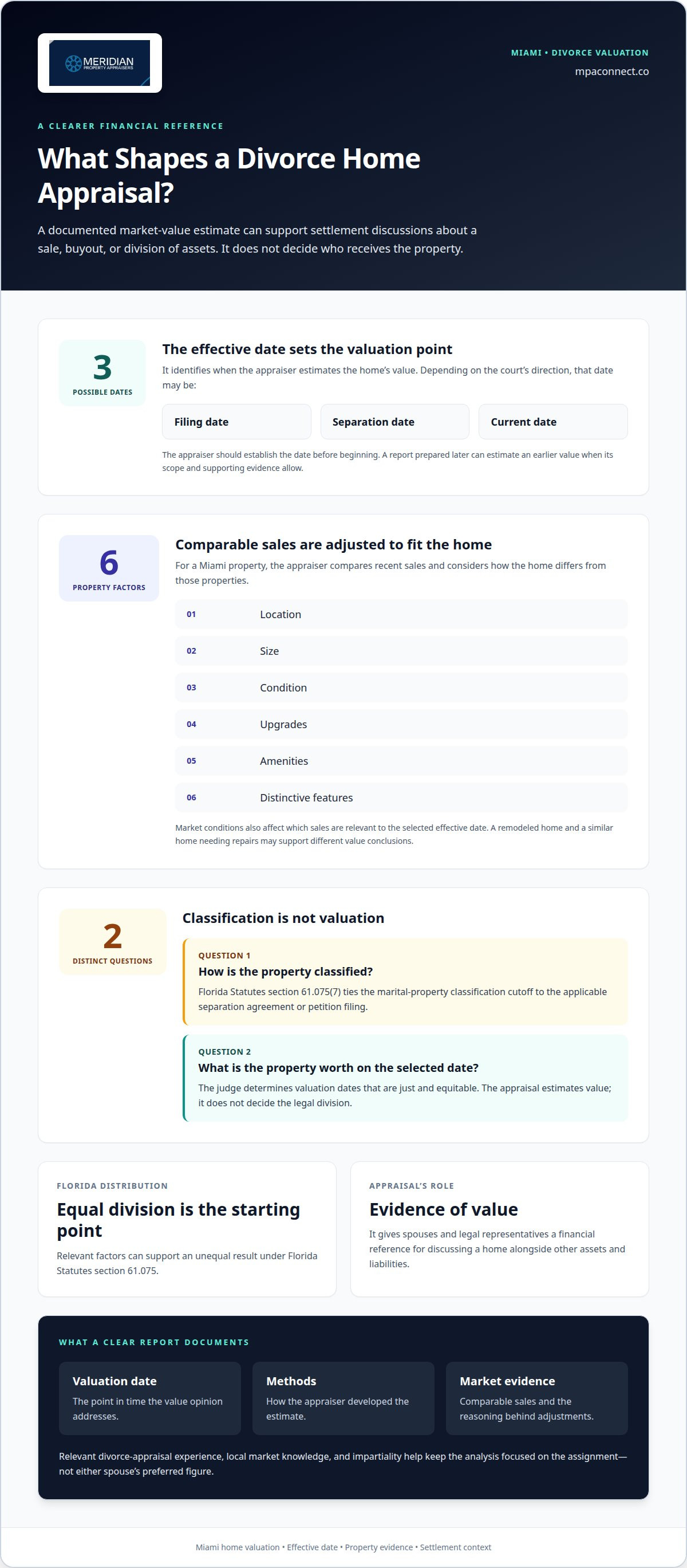
Classification and valuation are related, but they answer different questions. Under Florida Statutes section 61.075(7), the marital-property classification cutoff is tied to the applicable separation agreement or petition filing. The judge determines valuation dates that are just and equitable. A property may therefore require both a classification analysis and a separate estimate of its value on the date selected for the case.
The effective date identifies when the appraiser estimates value. Depending on the court’s direction, it may be the filing date, separation date, or current date. The appraiser should establish that date before beginning the assignment, because market conditions and property circumstances change over time. A report prepared in 2026 can estimate an earlier value when its scope and evidence support that retrospective date.
For a Miami home, the appraiser analyzes recent sales of comparable properties and adjusts for differences in location, size, condition, upgrades, amenities, and distinctive features. A remodeled home and a similar home needing repairs may support different conclusions. Market conditions also affect which sales are most relevant to the effective date.
An appraiser with relevant Florida credentials and divorce valuation experience can tailor the report to the assignment. The appraiser develops a value opinion from recognized methods and market data, rather than simply accepting either spouse’s preferred figure. Clarifying the effective date, property access, and assignment purpose helps focus the analysis on the valuation question.
Businesses may also need valuation analysis in a Florida divorce. A market-based approach compares sales of similar businesses, although unique operations can be difficult to match with reliable comparables. The Florida Legislature defines fair market value for a closely held business interest by what willing, able buyers and sellers would agree to when neither is compelled to transact and both know the relevant facts. Assets, liabilities, and goodwill may also affect the analysis.
A well-supported appraisal clarifies the real estate value used in settlement discussions, including when spouses are considering a sale or buyout. It can also show why two estimates differ, such as because of the effective date, comparable sales, property condition, or adjustments. Reviewing those components gives the parties and their legal representatives a more specific basis for discussing the property’s role in equitable distribution.
Fair market value and equitable division of marital property
Business, investment, and personal property require evidence suited to each asset. Real estate analysis relies on comparable sales and property-specific adjustments, while business valuation may examine assets, liabilities, income, or comparable business sales. Fine art, antiques, jewelry, and luxury vehicles may also require professional appraisal.
Florida Statutes section 61.075 provides for equitable distribution of marital assets and liabilities. Equal distribution is the starting point, but relevant factors can support an unequal division. Valuation gives attorneys and spouses a financial measure for comparing assets; it does not determine how a judge allocates them. A settlement can account for the value of a home alongside other property and liabilities.
The valuation date affects the figures used in that comparison. A home’s value at separation may differ from its value at filing or another date selected for the case. Matching the effective date to the required valuation period helps prevent a current estimate from being mistaken for a historical one. The chosen date also shapes which market evidence is relevant.
Separate and marital property can overlap. Florida Statutes section 61.075 addresses how marital contributions, mortgage principal payments, and appreciation can affect otherwise nonmarital property. For example, one spouse may have owned a home before marriage, while marital funds later reduced its mortgage principal. The value analysis and legal classification remain distinct questions, but accurate property details can help explain the claimed interest.
Business interests also require careful classification. A business acquired during marriage is generally presumed marital unless a premarital or postmarital agreement provides otherwise. A portion may also be marital if a spouse helped the business grow or marital funds supported it. Enterprise goodwill may be treated as a marital asset, while professional goodwill tied to an individual’s reputation, skill, or work is not.
The Florida Legislature defines fair market value for a closely held business interest by what willing, able buyers and sellers would agree to when neither is compelled to transact and both know the relevant facts. Business valuation may consider comparable sales, assets, liabilities, and expected income. Comparable sales can be difficult to apply to a unique company, so the method should fit the business and the available evidence.
For personal property and investments, the relevant evidence depends on the asset. Account records can document investment holdings, while market evidence can support values for collectible or tangible items. A sound comparison identifies the asset, valuation date, and evidence behind the estimate. This structure helps attorneys review unlike assets consistently and discuss each item’s contribution to a settlement.
A divorce appraisal can provide a documented real estate valuation for settlement discussions when spouses disagree about a property’s worth.
Finding appraisers through court and legal resources
In Miami-Dade divorce proceedings, appraisal reports may be submitted as evidence, and qualified appraisers can serve as expert witnesses. Legal resources help connect the valuation assignment to the questions a court must consider. An attorney can clarify the property, effective date, and issues the report needs to address. That scope gives the appraiser a defined task rather than a general estimate.
When spouses’ divorce appraisals differ, compare the effective dates, comparable sales, adjustments, and supporting reasoning. Different assumptions or market evidence may explain the gap. A side-by-side review can show whether the disagreement is about the data, methodology, or valuation date.
If you disagree with a Florida divorce appraisal, identify the specific issue, such as a property feature, comparable sale, or adjustment. Share the concern with your attorney and review whether the report explains its evidence and reasoning. A formal appraisal review can assess the comparables, adjustments, and conclusions in relation to the effective date.
A report is more useful in court when its analysis is clear and traceable. It should state the estimated value, explain the methods used, and provide supporting data. A narrative report or another format suited to the assignment may serve divorce work; a standardized mortgage form may not address the case’s needs. The report’s purpose and effective date should remain clear throughout.
Preparing to testify means being ready to explain the valuation, not defend a preferred outcome. In divorce appraisal work, an attorney provides the appraiser with questions before testimony. The appraiser can review the comparable sales, adjustments, and reasoning in the report, then practice a mock-trial interview with the attorney. This preparation connects each conclusion to the report’s evidence.
An appraisal review under USPAP Standard 3 assesses whether the comparables, adjustments, and reasoning are credible for the report’s effective date. If requested, the reviewer may also provide an independent value opinion. That distinction matters: reviewing another appraiser’s work and developing a separate valuation are related, but different assignments.
Legal and court resources can also help clarify how appraisal evidence is presented. Appraisers may attend public proceedings to observe courtroom procedures and testimony, while attorneys can explain the case’s questions and presentation needs. When assessing an appraiser’s fit, consider specific divorce valuation experience and the ability to explain methods plainly. A focused report, prepared for its stated date and purpose, gives the spouse and court a clearer basis for evaluating the property’s value.
Appraisal documentation for divorce proceedings
A well-documented appraisal shows how the value was developed, not just the final figure. In a Florida divorce assignment, the written report can identify the estimated value, valuation method, effective date, and supporting market data. These elements help attorneys understand what the appraiser examined and explain the conclusion during settlement discussions or court proceedings.
Cooperation improves the information available for analysis. Both parties should allow property access and provide relevant records. During an initial consultation, the appraiser may gather details about the property’s history, condition, and distinctive features. Permits, renovation records, photographs, and documentation of major repairs can help explain changes that affect comparisons with other properties.
Inspection timing matters. The property inspection should occur within 30 days of the valuation date. During the visit, the appraiser considers condition, features, and improvements. If one spouse knows about a renovation or a repair, sharing its date and records gives the appraiser a clearer basis for assessing that item. An inspection does not replace market research; it helps explain how the subject differs from comparable properties.
Market support should be traceable in the report. Divorce appraisal analysis should review at least three comparable sales and adjust for differences such as upgrades, amenities, and unique features. A useful report explains why each comparable was selected and how its differences influenced the analysis. If a sale is less similar, the written reasoning helps readers understand its role rather than treating every sale as equally persuasive.
Property records: ownership history, renovation details, and information about condition or improvements.
Inspection notes: observed features, condition, and items that distinguish the property.
Market evidence: comparable sales, relevant adjustments, and the reasoning behind their use.
Assignment details: effective date, intended purpose, methods, and final value conclusion.
These materials also support organized workfile practices. The appraiser can keep source information, inspection notes, comparable-sale details, calculations, and explanations for adjustments in a consistent record. That organization makes it easier to follow how the evidence supports the reported value and to answer questions about a particular sale or property feature.
Divorce reports may use a narrative format or another format suited to the assignment, rather than a standardized mortgage form. Government-Sponsored Enterprise (GSE) forms are not appropriate for divorce appraisal assignments. A clear report connects its scope, valuation date, methods, and supporting data, helping the parties understand the work without mistaking a form designed for another purpose for a complete divorce appraisal.
Agreeing on the appraiser and effective date before the assignment begins helps keep the work focused. The report can then document the inspection, research, methodology, and conclusion in one coherent record. If the court changes the valuation date, a Florida residential divorce appraisal can be updated or given a second effective date, with the revised analysis tied to the new assignment scope.
Appraiser qualifications and impartiality
In Florida divorce cases, qualifications and neutrality affect how an appraisal can support settlement discussions. Review an appraiser’s state credentials, local market experience, and experience with divorce-related valuation assignments.
Appraiser Qualifications and Experience
A qualified appraiser has relevant state licensing or certification and experience with the property type and assignment. For a Miami residence, local knowledge helps interpret neighborhood sales and property differences. Divorce valuation experience matters because the effective date, intended use, and report format must fit the assignment. Ask how the analysis addresses those factors, rather than relying only on a general estate or mortgage assignment background.
Professional affiliations can be another factor when reviewing an appraiser’s background. For example, the Appraisal Institute is an organization whose membership may be checked. Membership alone does not establish experience with divorce cases. Look for relevant work experience and a clear explanation of how the appraiser will approach the property and valuation date.
Experience should be evident in the appraisal report. A useful report identifies the assignment’s scope, effective date, valuation methods, and reasoning. It connects the property’s characteristics to market evidence instead of simply stating a value. For a home with substantial renovations, for example, the appraiser should explain how those features affect the analysis and comparable evidence.
Impartiality and USPAP Compliance
Impartiality means developing an independent value opinion without favoring either spouse’s desired outcome. Real estate appraisals for divorce assignments must comply with the Uniform Standards of Professional Appraisal Practice, or USPAP. These standards support a disciplined process and transparent reporting. The appraiser’s role is to analyze evidence and report a value, not advocate for one side.
Before an assignment begins, clarify its intended use, effective date, property access, and report recipients. If both spouses agree on one appraiser, a written agreement about the assignment’s scope can help prevent confusion. Compensation should not depend on reaching a particular value, which would conflict with impartial analysis.
Check credentials through relevant state records and consider professional affiliations as one part of the appraiser’s background. Then assess whether the appraiser can explain the methodology in plain language. In a divorce case, the ability to discuss comparable selection, adjustments, and limitations helps attorneys and spouses evaluate the conclusion without treating the appraiser as either party’s representative.
Choose an appraiser whose qualifications match the assignment and whose work remains independent. For a Florida divorce appraisal, prioritize relevant state credentials, local experience, divorce valuation knowledge, and USPAP-compliant analysis. These factors help the parties assess the report based on its evidence and reasoning, rather than on which spouse requested it.
Meridian Property Appraisers: Pre-Probate Inherited Properties Appraisal
Meridian Property Appraisers Inc. offers a Divorce Appraisal for spouses who need a real estate valuation during settlement discussions. The appraisal provides a documented value for a Miami property, helping the parties and their legal representatives consider it alongside other marital assets. It is especially relevant when spouses disagree about a home’s value or need an appraisal for a potential sale or buyout. Meridian Property Appraisers Inc. also offers a Pre-Probate Inherited Properties Appraisal for inherited property valuation needs.
If an impartial property valuation would help clarify your settlement discussions, contact Meridian Property Appraisers Inc. or visit mpaconnect.co.
Move Toward a Clearer Settlement
Property decisions can feel difficult when each spouse sees the numbers differently. A fair market value appraisal for a divorce settlement in Miami gives settlement discussions a defined reference point, while legal decisions about distribution remain separate. Start by identifying the property to be valued and aligning the appraisal’s purpose with the question your settlement needs to address.
Meridian Property Appraisers Inc. offers Divorce Appraisal services for property valuation during divorce, alongside Pre-Listing Appraisal and Pre-Probate Inherited Properties Appraisal services for other property needs. If a real estate valuation would help you move your settlement discussions forward, contact Meridian Property Appraisers Inc. to discuss the appraisal process.
A well-grounded valuation can make the next conversation more focused. Take the next step with an appraisal that supports clear, informed settlement discussions.
Frequently Asked Questions
How are scope and fees estimated?
Scope and fees depend on the assignment’s purpose, property, effective date, inspection needs, research, and reporting requirements. A Miami home valuation may require different analysis from an assignment involving multiple properties or an earlier valuation date. Fees are case-dependent and provided after a quote request. Relevant local markets include Miami, Tampa, Saint Petersburg, Orlando, Jacksonville, Clearwater, Largo, Pinellas Park, Seminole, and Fort Lauderdale.
How do you value real estate in a high asset divorce?
Each property is analyzed according to its characteristics, use, and valuation date. For example, a residence and an income-producing rental property may call for different evidence: comparable sales can inform a home’s value, while rental income may be relevant to an income approach. A complete property schedule helps distinguish assets, especially when spouses own multiple homes, investment properties, or real estate with different ownership histories.
How long does an appraisal take, and what affects timing?
Timing depends on property access, record availability, the complexity of the assignment, and the research and reporting required. The inspection for a divorce appraisal should occur within 30 days of the valuation date. A property with extensive renovations or unusual features may require more analysis than a straightforward residence. Prompt access and organized property records help the appraiser complete the inspection and valuation work efficiently.
What does “qualified appraiser” and USPAP-compliant mean?
A qualified appraiser has relevant state credentials and experience suited to the property and divorce assignment. USPAP is the Uniform Standards of Professional Appraisal Practice, and real estate appraisals in divorce assignments must comply with it. For a Miami residence, local market experience helps the appraiser analyze neighborhood evidence. Review the appraiser’s background for divorce valuation work, not just general residential assignments.
Why do intended use and valuation date matter?
Intended use tells the appraiser what the assignment must address, such as settlement discussions or court proceedings. The valuation date identifies when the value is estimated, so the market evidence must relate to that period. A current inspection or sale may not describe conditions at an earlier effective date. Defining both elements at the outset aligns the research, report, and questions the appraisal is meant to answer.
What does fair market value mean in a Florida divorce appraisal?
A fair market value appraisal estimates a property’s market value at a defined point in time, supported by relevant evidence. For a closely held business interest, the Florida Legislature describes fair market value as the price willing, able buyers and sellers would agree to when neither is compelled to transact and both know the relevant facts. An appraisal informs financial discussions but does not determine the legal division.
When is the valuation date for marital property in a Florida divorce?
There isn’t one automatic date for every valuation. Under Florida Statutes section 61.075(7), the marital-property classification cutoff is tied to the applicable separation agreement or petition filing, while the judge determines valuation dates that are just and equitable. The effective date may be the filing date, separation date, or another date directed for the case. Confirming the applicable date helps ensure the appraisal addresses the intended period.
How is a Miami home appraised for divorce settlement?
A fair market value appraisal for a divorce settlement in Miami considers the home’s condition, features, and location alongside comparable sales. The appraiser analyzes at least three comparable sales and adjusts for relevant differences, such as improvements or amenities. Two similar homes, for example, may support different conclusions if one has upgrades or a distinctive feature. The report connects those comparisons and adjustments to its value opinion.



Comments