
Florida Alternatives to Appraisal Management Companies and Regulation
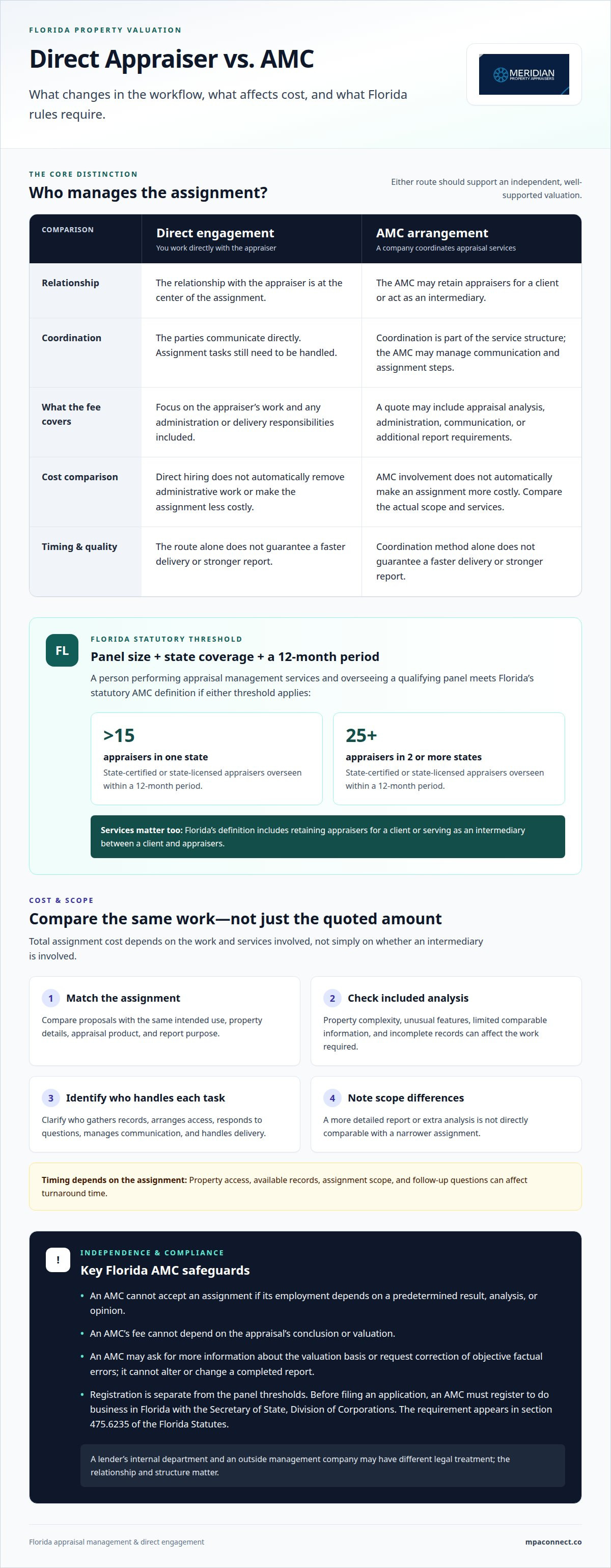
A direct engagement with a local appraiser can be an appraisal management company alternative in Florida. Florida’s statutory definition covers a person who performs appraisal management services and oversees a panel of more than 15 state-certified or state-licensed appraisers in one state within a 12-month period, or 25 or more in two or more states within a 12-month period. The key distinction is whether an intermediary coordinates or manages the appraisal, or you engage an appraiser directly.
An appraisal management company can retain appraisers for a client or act as an intermediary. A direct engagement puts the relationship with the appraiser at the center. Either way, the valuation should be independent and well supported. Understanding the process helps you choose the right route.
This guide explains Florida’s rules for appraisal management companies, the meaning of statutory thresholds, and how direct local appraisals compare with managed services. It also covers when a direct appraisal may fit your needs and what to weigh when choosing a property valuation.
Table of Contents
What is the cost of using an AMC versus hiring an appraiser directly in Florida?
How do Florida banks and credit unions manage appraisals without an AMC?
What are the pros and cons of appraisal technology platforms versus traditional AMCs?
How can a Florida lender build a compliant panel of independent appraisers
Meridian Property Appraisers: Pre-Probate Inherited Properties Appraisal
Appraisal management services
Appraisal management services coordinate or manage appraisal work for compensation. Florida’s definition includes retaining appraisers for a client or serving as an intermediary between a client and appraisers.
Florida’s AMC Definition and Rules
Florida’s panel thresholds determine when a person performing those services meets the statutory definition of an appraisal management company. The threshold is more than 15 state-certified or state-licensed appraisers in one state within a 12-month period, or 25 or more in two or more states within a 12-month period. Both tests concern a panel the person oversees.
Registration is a separate step. Before filing an application, an appraisal management company must register to do business in Florida with the Secretary of State, Division of Corporations. The registration requirement appears in section 475.6235 of the Florida Statutes. A lender’s internal department and an outside management company may have different legal treatment, so the relationship and structure matter.
Florida law bars an AMC from accepting an assignment if its employment depends on a predetermined result, analysis, or opinion. Its fee also cannot depend on the appraisal’s conclusion or valuation. An AMC may ask for more information about the valuation basis, including additional comparable data, or request correction of objective factual errors. It cannot alter or change a completed report.
Appraisal Technology Platforms and Traditional AMCs
An appraisal technology platform uses digital tools to route assignments and manage communication. A traditional AMC coordinates appraisal services as an intermediary. A platform can organize assignment details and status updates, while an AMC may coordinate between the institution, appraiser, and other employees. This is an operational distinction, not evidence of better real estate analysis. The appraiser’s independent judgment remains central.
Turnaround Times and Appraisal Quality
Turnaround time is the time from assignment to delivery; appraisal quality concerns the report’s support and accuracy. Neither route guarantees a faster timeline or stronger report for every Florida assignment. Property access, available records, assignment scope, and follow-up questions can affect timing. Quality depends on relevant comparable data, clear reasoning, and correction of objective factual errors, not the routing method alone.
AMC and Direct Appraiser Costs
AMC costs include coordination alongside appraisal work, while direct hiring focuses on the appraiser’s work. Total cost depends on the assignment scope, property complexity, report purpose, and coordination needs, not on a universal cheaper option. A quote reflects the specific assignment. With either route, clarify who handles communication, assignment details, and delivery so you can understand what the fee covers.
What is the cost of using an AMC versus hiring an appraiser directly in Florida?
Total assignment cost means the amount charged for completing the appraisal and related coordination. In Florida, the comparison depends on the assignment’s scope, the property, and what each proposed service includes, not simply on whether an intermediary is involved.
An AMC arrangement and a direct engagement can package work differently. A quoted amount may cover appraisal analysis, assignment administration, communication, or additional report requirements. Don’t assume every AMC lists coordination separately or that direct hiring removes all administrative work. Compare the deliverables and responsibilities stated for the specific assignment.
Assignment scope is the purpose and work defined for the report. For example, a valuation for a real estate listing may require different analysis and documentation from one for a legal or tax matter. Intended use, property characteristics, available records, and requested report format can all affect the work. Compare assignments with matching scopes rather than unrelated quotes.
Compare the same work
Review each proposal side by side. Note the property and intended use, appraisal product, included work, and any stated coordination or delivery terms. Then identify differences that could change the scope. If one proposal includes a more detailed report or extra analysis, its total is not directly comparable with a narrower assignment. Clear scope prevents a low initial figure from obscuring what the work includes.
Coordination cost is the value of organizing communication and assignment steps. With an AMC, coordination may be part of the service structure. In a direct arrangement, the parties communicate directly, but the time and tasks still exist. Consider who gathers records, arranges access, responds to questions, and manages delivery. These responsibilities help explain what a proposal covers without assuming a standard fee model.
Factors that change the comparison
Property complexity can affect the amount of analysis required. A home with unusual features, limited comparable information, or incomplete records may need more appraisal work than a straightforward property. The valuation’s purpose matters too: a report for a personal financial decision may differ from one for a formal proceeding. Compare the appraiser’s stated work rather than relying on a general market average.
Match the appraisal purpose and property details.
Compare included analysis, report format, and coordination.
Identify who manages records, access, questions, and delivery.
Review whether each proposal describes the same deliverables.
For a Florida property valuation, request an appraisal quote with the assignment purpose and property details so the proposed scope can reflect the work required.
How do Florida banks and credit unions manage appraisals without an AMC?
An internal appraisal office is a department or business unit within a financial institution that manages appraisal assignments. The Florida Legislature states that the state’s appraisal management company registration section does not apply to a financial institution that owns and operates an internal appraisal office, business unit, or department. This is a limited registration rule, not a blanket exemption from every appraisal requirement.
Separate internal management from outside coordination
A bank or credit union with an internal office keeps assignment management within its own institution. The office can organize requests, communicate with appraisers, and track report delivery. By contrast, an AMC is an intermediary business that coordinates appraisal services for compensation. The distinction depends on the institution’s ownership and operation of its internal unit, not simply on software use or a direct appraiser relationship.
For example, a Florida credit union could send a property assignment to its appraisal department. The department would record the purpose, property details, and delivery requirements, then coordinate the assignment and communicate with the appraiser. This is an example of a practical workflow, not a separate statutory checklist.
Build a clear assignment workflow
A defined workflow helps a financial institution organize appraisal work without an outside AMC. Staff can document the assignment’s purpose and relevant property information, identify the appraiser relationship, share required materials, and record key communications. When the report arrives, the responsible department can track receipt and route it to the appropriate internal team.
For a real estate loan file, this sequence creates a clear record of the request and report. The institution can distinguish appraisal analysis from administrative handling. That distinction also helps employees direct questions to the right person instead of sending every request through a general lending channel.
Keep appraisal judgment independent
Independent appraisal judgment means the appraiser’s analysis and opinion remain their own. Internal coordination does not make a particular appraisal result a target. A sound process keeps communication focused on assignment facts, report requirements, and objective errors. For example, staff can organize property records and clarify the intended use without directing a particular valuation conclusion.
Florida law also sets boundaries for appraisal management companies. An AMC cannot accept an assignment when its employment depends on a predetermined result, analysis, or opinion, or when its compensation depends on the appraisal’s conclusion or valuation. These provisions apply to AMCs, but they illustrate why assignment administration and valuation judgment should remain distinct.
Know where the exemption applies
The Florida Legislature’s stated exception concerns registration under the state’s appraisal management company registration section. It applies to a financial institution that both owns and operates the internal office, unit, or department. A lender should distinguish an institution-run operation from outside coordination when describing its model. The exemption does not establish that every appraisal activity, employee, or transaction follows identical rules.
What are the pros and cons of appraisal technology platforms versus traditional AMCs?
An appraisal technology platform is software used to organize appraisal assignment information and workflow. For a Florida lender, it can provide a shared place to manage documents, status updates, and assignment steps. Its value depends on how the lender and appraiser use it. Software can support coordination, but it does not replace the appraiser’s analysis or professional judgment.
Technology platforms: organized workflow, active oversight
A platform can make assignment details easier to track across a lender’s employees and appraisal team. Staff can use a consistent process to record the property, assignment purpose, and relevant documents. A shared workflow may reduce scattered communication across separate email threads and make handoffs clearer when an assignment moves between staff members.
The tradeoff is that people must maintain accurate records and act on updates. If someone enters a property detail incorrectly, a platform can carry that error through the workflow. A lender also needs a process for handling questions, exceptions, and report delivery. Technology organizes information; the people using it remain responsible for meaningful communication and review.
Traditional AMCs: managed coordination, intermediary role
A traditional appraisal management company coordinates appraisal services between a client and appraisers. This model gives the client an intermediary for assignment administration and communication, which can be useful when the institution wants coordination handled outside its own department. The tradeoff is another organizational layer between the client and appraiser, which can shape how questions and updates move through the process.
For a Florida assignment, the client’s needs determine whether an intermediary is useful. A lender with a steady internal workflow may prefer direct coordination supported by software. An institution seeking outside assignment management may value an AMC’s coordinating role. Neither structure determines report quality by itself. The appraiser’s work and the assignment’s clear requirements still matter.
Compare responsibility, not the label
Florida’s statutory definition focuses on the appraisal management services a person performs, not on whether they call their product a technology platform. A digital tool and an AMC are not automatically interchangeable categories. Review who retains appraisers, coordinates assignments, and communicates with the client. The responsibilities performed provide a more useful comparison than a platform’s name or interface.
Use these steps to assess the fit:
List which assignment tasks the institution wants to manage internally.
Identify who handles communication, records, questions, and delivery.
Decide whether a software-supported internal process or outside coordination better fits that workflow.
Keep the appraiser’s analysis separate from administrative routing.
A platform can suit a lender seeking structured internal tracking, while an AMC can suit one seeking an intermediary coordinator. Compare the actual roles and workflow before choosing an approach for a Florida real estate assignment.
How can a Florida lender build a compliant panel of independent appraisers
An appraiser panel is a group of appraisers a lender can consider for assignments. Building a dependable panel starts with a defined process for credentials, assignment fit, and communication. In Florida, the Division of Real Estate within the Department of Business and Professional Regulation licenses and regulates appraisers and appraisal management companies.
Credential review is the process of confirming an appraiser’s professional standing before an assignment. A lender can keep a consistent intake record for each appraiser, including credential type and the assignment areas they handle. Organized information helps staff make considered assignment decisions and maintain accurate panel records.
For an appraisal management company, Florida law prohibits employing or retaining an appraiser whose registration, license, or certification is suspended or revoked to perform appraisal services or appraisal management services. This rule applies to AMCs. It should not be presented as the same statutory duty for every lender’s internal panel.
Assignment fit means matching the appraiser’s relevant experience and geographic familiarity to the property and report purpose. A lender can document the property type, location, intended use, and required report format before selecting an appraiser. For example, a distinctive home may call for a different fit than a typical residential property. A written rationale helps staff explain their selection consistently.
Independence controls are procedures that keep valuation judgment separate from assignment pressure. Lenders can provide accurate property information and clarify the assignment’s purpose while keeping communications focused on facts and report requirements. Asking an appraiser to consider additional property data differs from directing a desired value. Staff should preserve this distinction in assignment notes and follow-up records.
A practical panel process can include these steps:
Define the property types, locations, and appraisal purposes the institution needs covered.
Record each appraiser’s credential information and relevant assignment experience.
Match each assignment to the property, location, and stated report purpose.
Keep assignment communications and delivery records organized for the file.
Review panel information periodically and update records when credentials or coverage change.
Panel maintenance means keeping the roster useful as assignments and appraiser circumstances change. A lender can assign responsibility for updating records and documenting changes instead of relying on informal memory. If an AMC manages assignments, Florida’s prohibition on using an appraiser with suspended or revoked credentials is a key control. Clear records support consistent decisions across the institution.
For a specific Florida residential valuation, request an appraisal assignment with the property details and intended purpose.
Meridian Property Appraisers: Pre-Probate Inherited Properties Appraisal
Meridian Property Appraisers Inc. provides Pre-Probate Inherited Properties Appraisals for people assessing a home inherited from a loved one. The appraisal provides a documented property valuation to support estate-related decisions. It focuses on the real estate and its value, rather than appraisal assignment coordination through an AMC.
Turn to this service when you need a property valuation before making probate-related decisions. If you are planning a sale, facing a divorce, or addressing storm damage, a Pre-Listing Appraisal, Divorce Appraisal, or FEMA Appraisal may better fit the purpose of your valuation.
Contact Meridian Property Appraisers Inc. to discuss a Pre-Probate Inherited Properties Appraisal for your property.
Choose appraisal support that fits your next decision
The right appraisal route depends on the valuation’s purpose and the professional relationship you need. If you are considering an appraisal management company alternative in Florida, focus on finding an appraisal suited to your decision, whether you are preparing for a property sale or addressing a personal transition. A clear purpose, careful analysis, and a suitable report can help you make a more informed next move.
For property-specific valuation needs, Meridian Property Appraisers Inc. offers Pre-Probate Inherited Properties Appraisals, Pre-Listing Appraisals, and Divorce Appraisals. Each service is designed for a different circumstance, so start with the decision the valuation needs to support.
If you’re ready to discuss your property and appraisal needs, contact Meridian Property Appraisers Inc. A clear first conversation can help you move forward with greater confidence.
Frequently Asked Questions
What alternatives to appraisal management companies are available in Florida?
Florida alternatives include hiring an appraiser directly, using an institution’s internal appraisal office, or using technology to organize assignments. Direct engagement may be an appraisal management company alternative in Florida when you want to work directly with an appraiser. Meridian Property Appraisers Inc. provides local residential appraisal services in Tampa, Saint Petersburg, Orlando, Jacksonville, Clearwater, Largo, Pinellas Park, Seminole, Miami, and Fort Lauderdale.
Can Florida lenders use in-house appraisal departments instead of an AMC?
Yes. According to the Florida Legislature, a financial institution that owns and operates an internal appraisal office, business unit, or department is outside the scope of Florida’s appraisal management company registration section. The exception concerns that registration section, not every appraisal rule. For example, a bank can manage assignment administration through its own department while leaving valuation analysis to the appraiser.
Can Florida lenders directly hire appraisers without using an AMC?
Yes, lenders can engage appraisers directly, but the activities and panel structure matter under Florida’s AMC definition. A lender performing appraisal management services may meet that definition if it oversees more than 15 state-certified or state-licensed appraisers in one state within a 12-month period, or 25 or more in two or more states during that period. Florida’s Division of Real Estate licenses and regulates appraisers and AMCs.



Comments