
How to Choose a Neutral Divorce Appraiser in Jacksonville
A neutral divorce appraisal is most useful when both spouses jointly retain one independent appraiser and agree in writing on the scope and effective date. When choosing a neutral appraiser for a divorce in Jacksonville, consider experience with divorce appraisals, familiarity with the local market, impartiality, and the ability to explain the valuation if needed. The appraiser’s role is to provide a supported opinion of value, not to advocate for either spouse.
It’s understandable to want a clear, fair value before deciding whether to sell the home or have one spouse keep it. A neutral appraisal gives both parties a shared basis for discussing those options, but the result depends on the property, market evidence, and assignment terms.
This article explains how an appraiser estimates a home’s value, what to agree on before the work begins, and how the findings can inform a sell-or-keep decision. It also covers licensing, impartiality, and testimony, so you can assess what makes a divorce appraisal useful and credible.
Table of Contents
Need help with divorce appraisals?
Appraisal fees and report timing depend on the assignment, the property, and the work needed to support a credible opinion of market value. In a Jacksonville settlement involving a home, understanding these factors can help set realistic expectations for family law discussions and planning.
Appraisal Costs and Turnaround Time
A divorce appraisal fee reflects the property’s size, location, and complexity, while turnaround depends on the work required to complete the report. These factors matter when spouses need a valuation before making decisions about real estate. Reports for typical homes generally return in less than a week; unusual, unique, or high-end properties may take longer than a week.
Consider an appraiser’s fee in relation to the assignment’s scope rather than as a standard amount. A straightforward home may require less analysis than a distinctive property with complex features or few comparable sales. The fee depends on the case and is provided after a quote request; property size, location, and complexity affect the cost.
Report timing also depends on inspection access, property records, and relevant market evidence. Delays in arranging access or defining the effective date can affect when the appraiser can begin or complete the analysis. For example, an estate property with unusual features may require more research than a typical home with clear nearby sales.
Finding Qualified Divorce Appraisers
Jacksonville residents can hire an independent, state-licensed or certified appraiser to value real estate, with the assignment tailored to the property. A home appraisal addresses real estate market value, while a business or personal property valuation requires a scope suited to those assets. Matching the appraiser’s qualifications and the assignment to the property helps keep settlement discussions focused.
For a divorce involving a home, the report should describe the property, valuation method, market evidence, and final opinion of value. A neutral arrangement means both spouses jointly retain one appraiser, rather than either spouse hiring the appraiser alone. Before work begins, agree on the scope, effective date, inspection access, and report distribution.
In a contested case, each spouse may order a separate valuation, potentially doubling appraisal costs. A jointly retained appraiser can give both parties the same independent analysis when they agree to that approach. The report informs discussion; it doesn’t determine how the property or other assets must be divided.
Set the assignment’s scope and effective date before valuation work begins.
Arrange property access and establish who receives the report and when.
Use an appraisal suited to the asset, whether real estate, business interests, or personal property.
Estimating home value during divorce
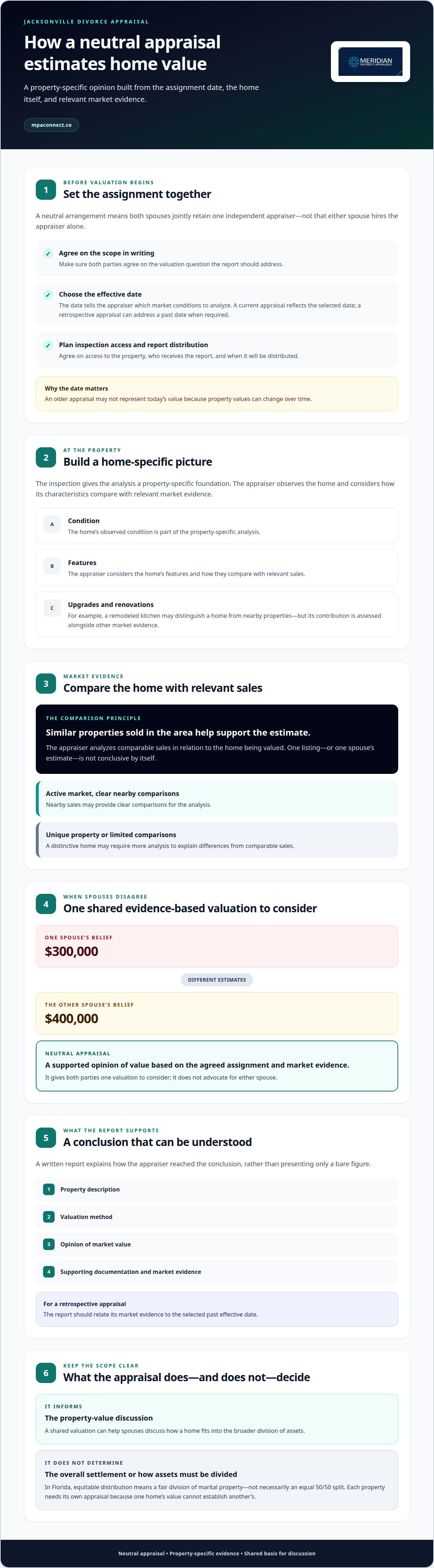
A divorce appraisal provides an independent opinion of a property’s fair market value for settlement discussions or court decisions. The valuation depends on the assignment’s effective date, the home’s characteristics, and relevant market evidence.
Before work begins, both spouses should agree in writing on the effective date and scope. The effective date tells the appraiser which market conditions to analyze. A current valuation reflects the market on the selected date; a retrospective appraisal can address a past date when the assignment requires it. An older appraisal may not represent today’s value because property values can change over time.
The inspection gives the analysis a property-specific foundation. The appraiser observes condition, features, and upgrades or renovations, then considers how they compare with relevant sales. For example, a remodeled kitchen may distinguish a home from nearby properties, but its contribution must be assessed alongside other market evidence.
Comparable sales help estimate fair market value by showing how similar properties have sold in the area. The appraiser analyzes those sales in relation to the home being valued, rather than treating one listing or a spouse’s estimate as conclusive. A home in an active market may have clear nearby comparisons. A unique property may require more analysis to explain differences.
Disagreement can be stark: one spouse may believe the home is worth $300,000, while the other believes it is worth $400,000. A neutral appraisal gives both parties one evidence-based valuation to consider. The appraiser is jointly retained, not selected by either spouse alone, and should not advocate for either person. Both parties should agree on the scope so the report addresses the same valuation question.
The written report describes the property, valuation method, opinion of market value, and supporting documentation. That detail helps spouses understand how the appraiser reached the conclusion instead of relying on a bare figure. For a past effective date, the report should relate its market evidence to that date.
For a couple with multiple properties, each property needs its own appraisal. Separate valuations account for each home’s condition, features, and comparable sales. This matters during division because one property’s value cannot establish another’s. In Florida, equitable distribution means a fair division of marital property, not necessarily an equal 50/50 split. The appraisal informs the property-value discussion; it does not determine the overall settlement.
With a shared valuation, spouses can discuss how the home fits into the broader division of assets. A neutral assessment clarifies the value question, while the settlement still depends on the full circumstances and agreed terms.
Appraisal: Deciding to Sell or Keep the Marital Home
A neutral appraisal gives spouses a shared estimate to consider alongside mortgage obligations, equity, and settlement terms. The value can help them compare selling the marital home with one spouse keeping it or continuing to co-own it.
Separate appraisers can reach different opinions because assignments may use different assumptions, comparable sales, or effective dates. In a contested case, hiring one appraiser for each spouse can double appraisal costs and leave the parties negotiating over two reports instead of one shared analysis. A neutral appraiser provides one independent valuation for discussion, provided both spouses agree to use that appraiser.
Selling converts the property into proceeds that spouses can divide under their agreement or a court order. If one spouse keeps it, that spouse may buy out the other’s share, often by refinancing the mortgage to remove the other spouse’s name and paying their share of the equity. Co-ownership is another option, but it requires ongoing coordination about expenses, maintenance, and future decisions.
An appraisal helps compare these options, but market value alone doesn’t determine which one is workable. For a potential buyout, consider whether the spouse keeping the home can qualify to refinance and manage future costs. For a sale, compare the appraised value with the expected proceeds after property-related obligations. Attorneys can use the valuation as one input when discussing settlement terms.
A lender generally requires its own independent appraisal when a homeowner refinances. That value may differ from the divorce appraisal, so a settlement agreement can include an appraisal contingency to address a difference. The agreement can specify how the parties will respond, helping reduce later disputes over the buyout amount.
Prepare by making the home and relevant details accessible for inspection, not by trying to stage a particular value. The appraiser assesses condition, features, and upgrades or renovations. Before the visit, organize records of completed improvements and note areas needing attention. For example, documentation of a kitchen renovation can describe the work accurately; the appraiser still evaluates its market contribution independently.
Agree on inspection access and notice arrangements so the appraiser can view the property.
Provide clear information about renovations, features, and property condition.
Use the appraisal as a value estimate, then assess refinance feasibility or sale proceeds separately.
Each option has practical trade-offs. A shared appraisal establishes a common starting point, while the spouses’ financial circumstances and settlement terms shape whether selling, a buyout, or co-ownership suits their situation.
Appraiser licensing and standards
For a Jacksonville divorce valuation, licensing is a basic qualification, not a substitute for careful analysis. Appraisals are performed by state-licensed or certified appraisers following strict standards, and only licensed appraisers can perform an appraisal. The parties benefit when the person preparing the opinion is qualified to appraise the specific property involved.
A real estate appraisal and a comparative market analysis are different assignments. A licensed real estate agent prepares a comparative market analysis using MLS data. An appraiser prepares a formal appraisal, providing an opinion of value supported by the assignment’s analysis and documentation. This distinction matters when spouses need a documented valuation for settlement discussions or disputes.
Licensing alone doesn’t establish whether an appraiser’s work suits a divorce matter. The assignment should identify the property, effective date, and intended use of the opinion. It should also define the scope of work, including which property is being valued and what question the appraisal addresses. Clear terms help both parties understand what the report covers.
Review the report’s reasoning, not just its final value. A formal divorce appraisal report may be 25-40 pages long. It includes a property description, valuation methodology, the appraiser’s opinion of fair market value, and supporting documentation. For example, the report should make clear how the property’s characteristics and relevant market evidence support the conclusion.
A consistent, evidence-based process is reflected in the report. The appraiser inspects the property, analyzes comparable sales, and explains how the analysis supports the opinion. If a spouse disputes the conclusion, documented reasoning gives the parties a specific basis for understanding the difference. A bare estimate without its methodology offers less context for discussion.
Before the appraisal begins, the parties can establish practical terms for a fair assignment:
Agree in writing on the effective date and scope of work.
Set inspection access arrangements, including notice and attendance expectations.
Specify who receives the report, when it is distributed, and through which channel.
Identify one point of contact for assignment communications.
These steps keep the appraiser’s role distinct from either spouse’s position. A neutral appraiser provides an opinion of value, not an argument for a particular property distribution. Clear assignment terms and an explanation of the analysis give both parties a shared reference for discussing value. If the matter proceeds to a hearing, clear methods and supporting documentation also make the valuation easier to explain.
Appraiser objectivity and court testimony
A neutral appraiser bases the valuation on market evidence, property characteristics, and assignment requirements. That independence matters when a Florida divorce involves a home among the couple’s assets.
Appraiser Objectivity
Objectivity means forming a credible opinion of value without advocating for either spouse. The appraiser considers the home’s characteristics and comparable market evidence, then explains how they support the conclusion.
This matters because the appraisal may inform settlement negotiations or court decisions about property. In a properly structured neutral engagement, assignment communications use one point of contact, without either spouse’s counsel filtering messages. Agree on inspection access and report distribution before work begins so each party receives the same valuation information.
Questioning a Jointly Retained Appraiser
Either spouse can question a jointly retained appraiser about the valuation, including its methods, comparable sales, and supporting evidence. If the case reaches a hearing, the appraiser’s ability to explain the analysis matters. A neutral engagement doesn’t prevent either party from disputing the opinion.
Useful questions focus on the report. For example, a spouse may ask how a selected comparable relates to the home or how a documented renovation affected the analysis. Specific questions about evidence can clarify a disagreement more effectively than simply rejecting the estimate.
In a Florida divorce, the neutral appraiser’s report provides a professional opinion of fair market value. It can support settlement discussions or court decisions concerning the home and equitable distribution of marital property. The report informs the value assessment; it doesn’t determine how spouses must divide their assets.
For a report to be useful in a dispute, its reasoning should be clear enough to explain. The appraiser should connect the property’s features, condition, and relevant market evidence to the valuation conclusion. If testimony is needed, this explanation lets the appraiser address questions about the analysis rather than advocate for one spouse’s preferred result.
Joint retention also requires clear engagement terms. The spouses should agree on the assignment’s scope and effective date, inspection access, and report distribution. A single point of contact can keep communications orderly and prevent either party from controlling what information reaches the appraiser.
Before the engagement begins, the parties can establish a practical communication protocol:
Identify one point of contact for assignment-related messages.
Set inspection access and notice arrangements for the home.
Agree on report recipients, timing, and delivery channel.
Keep questions focused on the report’s methods and evidence.
These arrangements create a shared record for both spouses and their attorneys. If a hearing follows, a well-supported opinion gives the appraiser a clear basis for explaining the valuation and responding to questions. To discuss an independent divorce valuation for a Jacksonville property, request a divorce appraisal.
Meridian Property Appraisers Inc.: Divorce Appraisal
Meridian Property Appraisers Inc. provides divorce appraisal services for spouses who need a professional home valuation for settlement discussions or a court matter. The appraisal considers the property’s condition, features, and relevant market evidence to support an opinion of value.
Use this service when you need a valuation to inform a sell-or-keep decision, discuss a potential buyout, or establish a shared basis for negotiations. Before work begins, define the effective date, scope, inspection access, and report distribution. Clear terms help both parties understand what the appraisal addresses and how the report will be shared.
If you’re preparing for a divorce-related property valuation, contact Meridian Property Appraisers Inc. to discuss your appraisal needs.
Set a Clear Next Step for Your Property Decision
The appraisal process can help coordinate next steps as you and your spouse plan ahead. Agreeing on the valuation’s purpose and how it will inform settlement discussions can keep property decisions focused. For Jacksonville couples, choosing a neutral appraiser for a divorce means seeking an independent perspective that supports informed discussion without taking sides.
Meridian Property Appraisers Inc. offers Divorce Appraisal, Pre-Listing Appraisal, and Pre-Probate Inherited Properties Appraisal services. If a divorce-related property valuation is your next step, contact Meridian Property Appraisers Inc. to discuss the appraisal. A careful, well-defined process can help you move forward with greater clarity.
Frequently Asked Questions
Can both parties rely on the same appraisal?
Yes, both parties can use one appraisal when they jointly retain the appraiser and agree to rely on the report. For example, spouses can give shared instructions for valuing the home and arrange for both to receive the completed report. This gives each party the same valuation to consider during negotiations. The report provides an opinion of value; the spouses or court address how it affects the property settlement.
What happens to your home when you get a divorce?
The home may be sold, kept by one spouse through a buyout, or co-owned after the divorce, depending on the agreement or court order. For example, a spouse who keeps the property may refinance and pay the other spouse’s share of the equity. An appraisal helps establish a value for discussion, but it doesn’t decide who receives the home or determine the full division of marital assets.
Can the appraisal be based on a past date?
Yes, an appraisal can provide a retrospective value for a specified past date. This can help when a settlement needs to consider the property’s value at an earlier point rather than today’s value. Agree on the effective date and include it in the assignment before valuation work begins. The appraiser then analyzes market evidence relevant to that date, not just current conditions or an older report’s conclusion.
Can you work with attorneys?
Yes, appraisers can work with attorneys on a divorce valuation assignment. The parties should establish how communications will be handled, including the point of contact and report distribution. For example, counsel can help coordinate inspection access and clarify the valuation question in the engagement terms. The appraiser provides an independent property valuation, not legal advice or advocacy for either spouse.
How do you choose a neutral appraiser for divorce in Jacksonville, Florida?
When choosing a neutral appraiser for a divorce in Jacksonville, look for a state-licensed or certified appraiser with divorce assignment experience, local market familiarity, and the ability to explain findings if testimony is needed. Both spouses should agree on the appraiser and assignment terms. Before work starts, settle the valuation date, scope, inspection arrangements, and report recipients. These steps create a clear process and a shared basis for discussing the home’s value.
What qualifications should a divorce appraiser in Florida have?
A divorce appraiser in Florida should be state-licensed or certified and experienced in producing divorce valuation reports. Relevant experience matters because the appraiser must clearly explain the analysis and supporting market evidence. If a hearing is possible, the appraiser should also be able to explain the methods and conclusions in testimony. Match the assignment to the appraiser’s qualifications and the property being valued, such as a residential home.
How can spouses verify a Jacksonville appraiser’s credentials and experience?
Ask for the appraiser’s license or certification details and confirm that the credential applies to the work requested. Discuss experience with divorce valuations, local property types, and explaining reports at a hearing. A practical step is to review a sample report with private information removed, focusing on how clearly it describes the property and supports its opinion. Both spouses can raise these points together before agreeing to the assignment.
What does a neutral divorce appraisal cost in Jacksonville, Florida?
The fee depends on the case and is provided after a quote request; property size, location, complexity, and assignment scope affect the cost. For example, an unusual home may require more analysis than a straightforward property with relevant nearby sales. Clarify whether the assignment covers a current or retrospective valuation and how many properties it includes. If spouses hire separate appraisers in a contested case, their combined appraisal costs can double.



Comments