
Inherited Property Appraisal and When Capital Gains Tax Is Due
An inherited property can trigger capital gains tax when it sells for more than its adjusted basis, not simply because it changed hands. Avoiding capital gains on inherited property often starts with an accurate appraisal: under Section 1014, the basis generally reflects the property’s fair market value on the owner’s date of death. The appraisal establishes that starting point; it doesn’t erase a gain that accrues afterward.
It’s understandable to want a clear tax answer before deciding whether to sell, keep, or improve an inherited home. The key comparison is between the sale proceeds, after applicable selling expenses, and the adjusted basis, which can increase with capital improvements. A sale near the value on the date of death may leave little gain, while a later sale at a higher value may create one.
This article explains how an appraisal affects the calculation, when a gain or loss may arise, and what a decline in value can mean. It also explains why a well-supported date-of-death valuation and clear records can make the tax calculation easier to follow.
Table of Contents
When do you pay capital gains tax after inheriting property?
Capital gains tax may apply when inherited property sells for more than its adjusted basis. The calculation depends on sale proceeds, relevant selling expenses, and the property’s value when the owner died. For heirs concerned with avoiding capital gains on inherited property, an accurate appraisal helps establish the starting value, but it does not erase appreciation after inheritance.
Date-of-Death Appraisal and Stepped-Up Basis
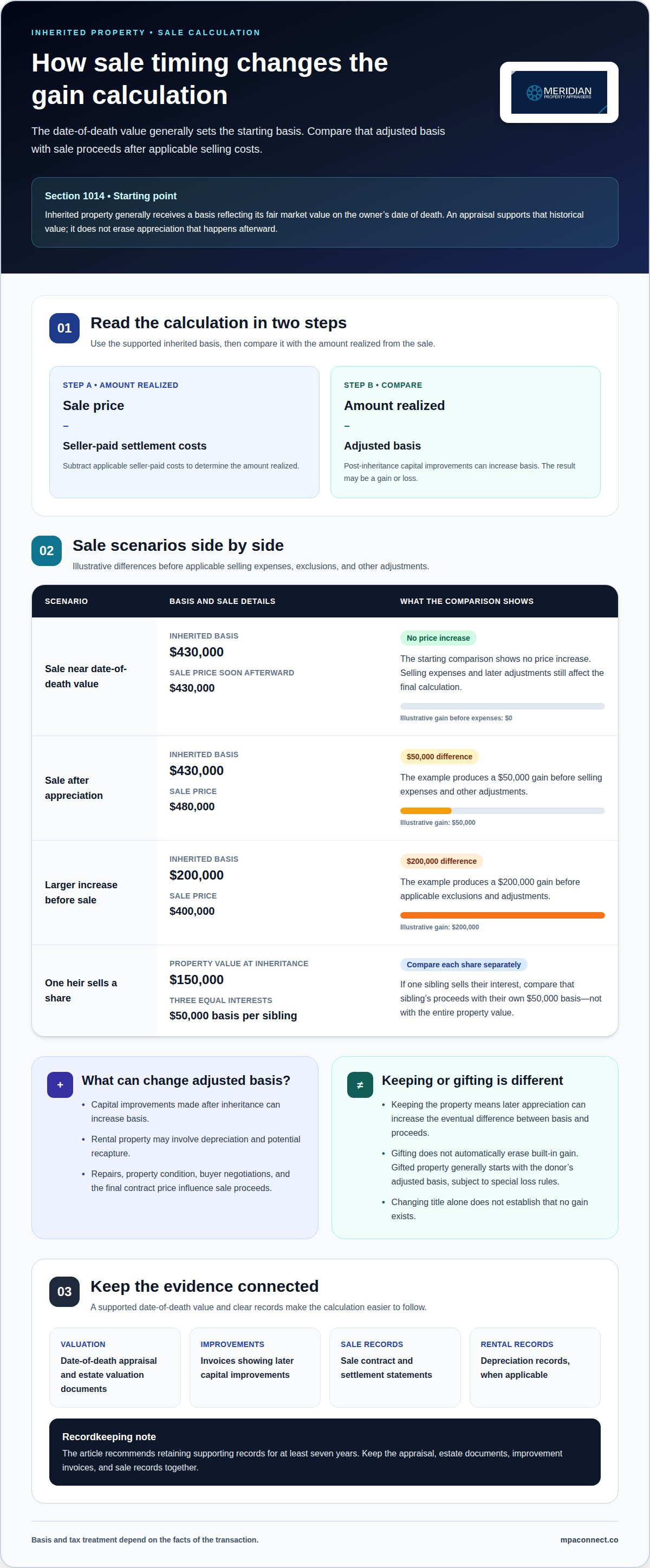
A date-of-death appraisal estimates fair market value when the owner died, which generally establishes the inherited property’s stepped-up basis under Section 1014. That historical value matters because it separates appreciation during the decedent’s ownership from later changes. A retrospective professional appraisal can support the value even when prepared afterward. For example, a $430,000 basis and a $480,000 sale produce a $50,000 gain before selling expenses and other adjustments.
To calculate the result, subtract seller-paid settlement costs from the sale price to determine the amount realized, then compare it with adjusted basis. Capital improvements made after inheritance can increase basis. An appraisal should address the property’s condition and market value on the relevant date, rather than substitute a later tax assessment or current price.
State Tax Rules and Basis Adjustments
State inheritance and estate tax rules concern taxes on an estate or beneficiary; they do not replace the federal basis calculation. For 2026, the Internal Revenue Service states the U.S. federal basic estate tax exclusion amount is $15 million. The inherited property’s fair market value at death generally remains central to basis under Section 1014.
For the Section 121 home-sale exclusion, the Internal Revenue Service generally requires ownership for at least 24 months during the five-year period ending on the sale date. Qualifying investment real estate may use a Section 1031 exchange. The Internal Revenue Service generally requires written identification of replacement property within 45 days and receipt within 180 days, subject to the return-due-date limitation. Rental property may also involve depreciation and potential recapture.
Records Supporting Appraisal and Tax Basis
Keep the appraisal, estate valuation documents, improvement invoices, and sale records together. The executor may have information about fair market value on the date of death. These records connect the appraisal to the estate’s valuation and show which later improvements affected adjusted basis.
A sound approach to avoiding capital gains on inherited property starts with a clear record of the valuation date and supporting evidence. Keep settlement statements and rental depreciation records as well. Retain supporting records for at least seven years to help explain the basis and sale figures used when reporting the transaction.
Selling soon after inheritance
A quick sale can simplify an estate, but speed alone doesn’t determine whether the sale creates taxable gain. The inherited basis usually starts with fair market value at the owner’s death. If a home’s documented value was $430,000 and it sells soon afterward for $430,000, the starting comparison shows no price increase. Selling expenses and later adjustments still affect the final calculation.
Consider the difference between that sale and a property that appreciates before closing. A home with a $200,000 inherited basis sold for $400,000 produces a $200,000 gain before applicable exclusions and adjustments. A short interval between inheritance and sale may limit market movement, but it doesn’t guarantee identical values. Repairs, property condition, buyer negotiations, and the final contract price all influence the proceeds.
Before selling, the estate’s representative can provide information about the date-of-death value. A retrospective appraisal can document that value when the sale occurs later. Keep the valuation separate from the sale contract: one supports the inherited basis, while the other records the transaction. A Pre-Probate Inherited Properties Appraisal can establish a supported valuation for estate decisions before listing.
Keeping the property is another option, especially when heirs want to retain real estate as an asset or rental. Appreciation after inheritance can increase the eventual difference between basis and proceeds. Rental income may also affect reporting, and depreciation can influence adjusted basis and later tax calculations. Estate planning should address who will own the property, who receives income, and how expenses will be handled.
Gifting the property instead of selling it doesn’t automatically erase its built-in gain. A recipient of gifted property generally starts with the donor’s adjusted basis, subject to special loss rules. That differs from inherited property, which generally receives a date-of-death basis. For a spouse or co-owner, the tax result depends on whether the transfer is a gift, sale, or distribution. Changing title alone doesn’t establish that no gain exists.
For co-owned property, each heir’s share matters. If three siblings inherit equal interests in a home valued at $150,000, each has a $50,000 basis for their share. If one sibling sells their interest, their own share of the proceeds is compared with that basis, rather than with the value of the entire property. This distinction helps heirs assess a proposed buyout before agreeing to its terms.
What if the inherited property has dropped in value?
If inherited property sells for less than its basis, the sale may produce a capital loss rather than a taxable gain. The comparison starts with the property’s fair market value on the date of death, adjusted for later basis changes, then considers the seller’s share of proceeds after applicable selling costs. A later market decline does not reset the inherited basis. It changes the sale-side figure used in the calculation.
A loss is not automatically deductible just because the sale price fell. The inherited-property loss rule described here requires an arm’s-length sale to an unrelated person, property not used for personal purposes, and no intention to convert it to personal use before selling. For example, a home held for personal use may not qualify for a deductible capital loss, even if its sale proceeds are below its date-of-death value.
For federal reporting, a taxpayer with a filing requirement generally reports an inherited-property sale on Form 8949, Schedule D (Form 1040), or both. IRS Publication 550 provides information on reporting sales on Schedule D. The sale records should distinguish the inherited basis, amount realized, and any adjustments, so the return reflects the transaction rather than the deceased owner’s original purchase price.
Installment sales require particular care because the buyer pays over time instead of delivering all proceeds at closing. The contract’s payment terms affect when the seller receives proceeds, but spreading payments does not by itself eliminate a gain or establish a deductible loss. Tax treatment depends on the transaction and its reporting rules. Keep the signed agreement, payment records, and closing statement together for each tax year in which a payment is made.
Before choosing a strategy, distinguish a market decline from a basis error. An appraisal tied to the date of death supports the starting value; a current valuation describes a different point in time. If an inherited property is divided among three siblings, each owner reports their own share of the amount realized and basis. That allocation matters when one heir sells an interest while the others retain theirs.
A sale below basis may create a capital loss only when the relevant use and sale conditions are met. A sale above adjusted basis may still create taxable gain, even after the property’s value has declined from a later peak. Document the change in value, the buyer’s relationship to the seller, and how the property was used. These facts help determine whether loss treatment applies and how the sale should be reported.
Alternate valuation date
An alternate valuation date can affect the value used for inherited property’s basis, but it is not an automatic substitute for the date-of-death value. The executor must file Form 706 and elect the alternate valuation on that return for it to determine basis. An heir cannot create the election independently by obtaining a later appraisal or choosing a lower value.
That distinction matters when property values change between the owner’s death and later estate administration. A later appraisal may describe the property accurately as of its valuation date, but that alone does not establish that the alternate date applies for tax purposes. The relevant step is the executor’s Form 706 election. Without it, an heir should not treat a later valuation as the basis merely because it better matches a sale price.
For example, imagine an inherited home that declines in value after the owner’s death. The decline may affect what a buyer pays, but it does not itself transfer the basis to a later date. First determine whether the estate filed Form 706 and made the election. Then use the applicable estate valuation when calculating the heir’s adjusted basis and comparing it with sale proceeds.
Keep the estate return and appraisal records together. Form 706 can show whether the executor reported an election, while valuation documents explain the property’s condition and value at the relevant date. If the property was later sold, the closing statement records the amount realized. Those records help distinguish the estate’s tax valuation from the later transaction and any income tax calculation.
An appraisal prepared after death may still help reconstruct value on an earlier date. The report should address the property as it existed on the valuation date, rather than simply state its current condition or market price. For instance, later repairs or deterioration should not be confused with features present at death. This distinction helps align the estate’s valuation evidence with the date used.
Estate tax and income tax are related through valuation, but they are separate reporting questions. Form 706 concerns the executor’s estate-tax return and election; the beneficiary later uses the applicable basis when calculating gain or loss on a transfer or sale. If an estate used an alternate valuation, retain the return and supporting appraisal so the basis calculation follows that election. A new appraisal alone cannot replace the executor’s filing step.
For heirs, the practical sequence is clear: identify the valuation date used by the estate, locate Form 706 if filed, and match its election with the supporting appraisal. If no election appears, don’t assume a later value qualifies simply because it reduces a potential taxable gain. The return, election, and valuation evidence together determine which value supports the basis for tax purposes.
Capital gains tax on inherited property
For federal tax purposes, the key question is usually whether selling proceeds exceed the inherited property’s adjusted basis. The decedent’s original purchase price generally isn’t the heir’s starting point. Inherited property generally uses fair market value at death. Appreciation after that date can create taxable gain, while improvements and selling expenses can affect the calculation.
For 2026, federal long-term capital gains rates are 0%, 15%, or 20%, depending on filing status and taxable income. The 15% rate applies to single filers with income from $49,451 to $545,500 and married couples filing jointly from $98,901 to $613,700. The 20% rate applies above those ranges. The 0% thresholds are up to $49,450 for single filers and $98,900 for joint filers.
A home-sale exclusion may reduce gain when the inherited home becomes the heir’s principal residence. The Internal Revenue Service generally requires the owner to have owned and used the home as a principal residence for at least 24 months during the five-year period ending on the sale date. The exclusion may be up to $250,000, or $500,000 for certain married couples filing jointly, when applicable requirements are met. It reduces qualifying gain; it doesn’t change the home’s basis.
For a spouse or multiple heirs, calculate the interest each person receives rather than treating the whole property as one tax share. An inherited partial interest generally has a basis tied to the value of that inherited share. For example, if three siblings inherit equal shares of a home valued at $150,000, each share has a $50,000 basis. Appreciation and sale proceeds must be considered for the owner’s share.
A transfer by gift differs from an inheritance. A gift recipient generally starts with the donor’s adjusted basis, subject to special loss rules, while an heir generally starts with date-of-death value. That difference can affect future taxable gain, so estate planning should distinguish a lifetime gift from property received after the owner’s death. If an estate provides Schedule A to Form 8971, the recipient may have to report a basis consistent with the estate-tax value.
To assess your inherited property’s valuation, request an inherited-property appraisal that supports the relevant tax basis. A clear value record helps separate appreciation before the decedent’s death from changes afterward.
Meridian Property Appraisers: Pre-Probate Inherited Properties Appraisal
Meridian Property Appraisers Inc. provides Pre-Probate Inherited Properties Appraisals to help establish an inherited home’s value for estate decisions. Consider an appraisal when the estate needs a documented valuation before distributing property or planning a sale. A supported value can help heirs and estate representatives understand the basis used in later gain calculations. An appraisal itself does not eliminate capital gains tax.
The appraisal focuses on the property and relevant date, giving the estate a clearer record for its next steps. If the home is approaching the market, a Pre-Listing Appraisal can also address its value in a listing context. The appropriate appraisal depends on the decision at hand.
Contact Meridian Property Appraisers Inc. to discuss a Pre-Probate Inherited Properties Appraisal for your estate.
Make your next property decision with confidence
Before deciding whether to retain, sell, or transfer an inherited home, bring the valuation record and estate documents together. A clear file helps keep family discussions, property decisions, and tax reporting grounded in the same information. It also provides a stronger starting point for discussing a sale with an executor, co-owner, or tax professional.
A careful inherited-property appraisal can support a more informed approach to avoiding capital gains on inherited property, but it can’t guarantee a particular tax result. The appraisal documents value; ownership history, property use, transaction terms, and individual tax circumstances also matter. If the next step is a sale, consider how timing and each heir’s share fit the estate’s plans.
Meridian Property Appraisers also offers Pre-Listing Appraisal and Divorce Appraisal services for those distinct valuation needs. For help determining the appropriate appraisal for an inherited property, contact Meridian Property Appraisers. A measured next step can help you move forward with clearer records and greater confidence.
Frequently Asked Questions
How Is the Cost Basis of a Property Determined?
For inherited property, the starting basis generally reflects fair market value on the decedent’s date of death. The executor’s estate records and a retrospective appraisal can help establish that value. After inheritance, capital improvements can increase adjusted basis, while rental depreciation can affect it. Keep invoices and depreciation records together, because the basis used for a later sale should account for relevant changes after inheritance.
How do you report the sale of inherited property on your taxes?
Report the sale on Form 8949 and Schedule D (Form 1040), as applicable to your filing requirement. For the inherited asset’s acquisition date, enter “Inherited,” then report the sale date and amount realized. The amount realized generally starts with the sales price and subtracts seller-paid settlement costs. Keep the closing statement and basis records together so the reported figures can be traced to the transaction.
What if you live in or rent the inherited property before selling?
Living in the property can matter for the Section 121 home-sale exclusion. The Internal Revenue Service generally requires ownership for at least 24 months during the five-year period ending on the sale date; principal-residence use is also required for at least 24 months during that period. Renting it instead can introduce depreciation and income reporting. Form 4797 may apply to certain inherited rental or income-producing property assets and depreciation recapture calculations.
What is the step-up in basis, and why does it matter?
A step-up in basis generally means inherited property starts with a basis tied to fair market value when the owner died, rather than the decedent’s original purchase price. This matters because basis helps measure later appreciation after inheritance. For a Tampa home, a supported historical valuation can help distinguish value changes during the decedent’s ownership from those occurring while the heir held the property.
How is the stepped-up tax basis calculated for inherited property in the U.S.?
Start with the inherited property’s fair market value on the date of death, then adjust for relevant items after inheritance. Capital improvements increase adjusted basis, while rental depreciation can affect it. If an heir inherits a partial interest, the basis generally follows the value of that share, not the whole property. Estate valuation records and an appraisal support the starting figure used in the calculation.
What date determines the fair market value appraisal of inherited property?
The usual valuation date is the owner’s date of death. A retrospective appraisal estimates fair market value as of that historical date, even if the report is prepared later. The appraisal should describe the property as it existed then, rather than substitute its current condition or a later sale price. Estate records and information from the executor can help connect the valuation to the relevant date.
Can heirs use an alternate valuation date for inherited property tax basis?
An heir cannot choose a later valuation date independently. An alternate valuation date determines basis only when the executor files Form 706 and elects alternate valuation on that return. The estate’s filed return and supporting valuation documents show whether the election applies. A later appraisal can document value at another point in time, but it does not replace the executor’s required election for this tax treatment.
How are capital gains calculated when inherited property is sold?
Subtract adjusted basis from the amount realized to calculate gain or loss. The amount realized generally reflects the sale price less seller-paid settlement costs; improvements and other basis adjustments affect the comparison. A positive difference is a gain before applicable exclusions. The gain amount is not automatically the tax bill: filing status, taxable income, property use, and any eligible home-sale exclusion can affect the federal tax outcome.



Comments