
Reasons an Orlando Appraisal May Differ From the Asking Price
An Orlando appraisal below the offer can leave a gap the lender won’t cover in full. The buyer and seller can renegotiate, the buyer can bring additional cash, or the buyer may walk away if the contract allows. Recent comparable sales and the home’s condition can help show whether the asking price is supported. Justifying an asking price with an appraisal in Orlando means looking beyond a single number.
A gap between the offer and the appraisal can feel unsettling, but it doesn’t automatically settle the home’s value or dictate what happens next. Appraisers consider comparable sales, the property’s size, layout, condition, location, upgrades, and market conditions. This article explains why appraisals and offers can diverge, what appraisers weigh, and how a pre-listing appraisal can inform an Orlando asking price before the home goes on the market.
Table of Contents
1. Reasons a home appraisal may be below the contract price
An appraisal below the contract price can happen when the agreed amount exceeds what recent comparable sales support. In Orlando, changing neighborhood values, inflation, nearby foreclosures or short sales, poor maintenance, and overpricing can affect the appraiser’s estimate. Buyers and sellers may value a home differently from the market evidence available to the appraiser. The appraisal is an independent estimate, not confirmation that the contract price is reasonable.
Timing can contribute to a gap. In most Orlando home purchases, the lender orders an appraisal after the purchase agreement is signed. If local values have shifted since the parties negotiated, the report may reflect different market evidence. A seller’s asking price may be based on an informal comparative market analysis, while the lender’s appraisal is a formal valuation used for financing. The two assessments serve different purposes.
An appraisal is not a home inspection. The appraiser estimates market value using the property’s features, condition, location, and comparable sales. An inspector assesses the home’s physical systems and condition, including maintenance concerns. For example, a worn roof may affect the appraiser’s view of the home’s condition, but the appraisal does not replace a detailed inspection or provide the same findings.
To support the valuation, an Orlando seller can provide records documenting the home’s condition and improvements. Useful materials include renovation invoices, maintenance records, and a clear list of completed upgrades. Include dates and locations of the work when available. These documents give the appraiser context, but they don’t require the appraiser to adopt the asking price or assign a particular value to an improvement.
Prepare for the property visit by making access straightforward and ensuring rooms and major features are visible. Note upgrades that may not be obvious, such as replaced windows or updated plumbing, and organize supporting records. Accurate details matter: if the bedroom count or living-area measurement appears wrong, flag the specific discrepancy and provide documentation to explain it.
A low appraisal means the lender may not finance the full contract amount based on the appraised value. The buyer and seller can revisit the price, or the buyer may need additional funds to proceed. If the purchase agreement includes an appraisal contingency, the buyer may be able to withdraw and recover the earnest money deposit. Without one, walking away could put the deposit at risk and may lead to a dispute with the seller. Review the contract before deciding.
If the sale falls through, the seller may need to relist, reassess the asking price, and consider whether another financed buyer could face a similar appraisal issue. Appraisal fees depend on the property’s characteristics, the assignment’s scope, and its purpose. The exact fee is provided in a quote for your case.
2. Reasons appraisals and purchase prices differ
A purchase price records what a buyer and seller agree to exchange. An appraisal estimates market value using property details and comparable sales. The figures can differ because the offer reflects negotiation, urgency, or competition, while the appraisal assesses evidence about the home and its market. In Orlando, a buyer may offer above the asking price to secure a property, even when nearby sales don’t support that amount.
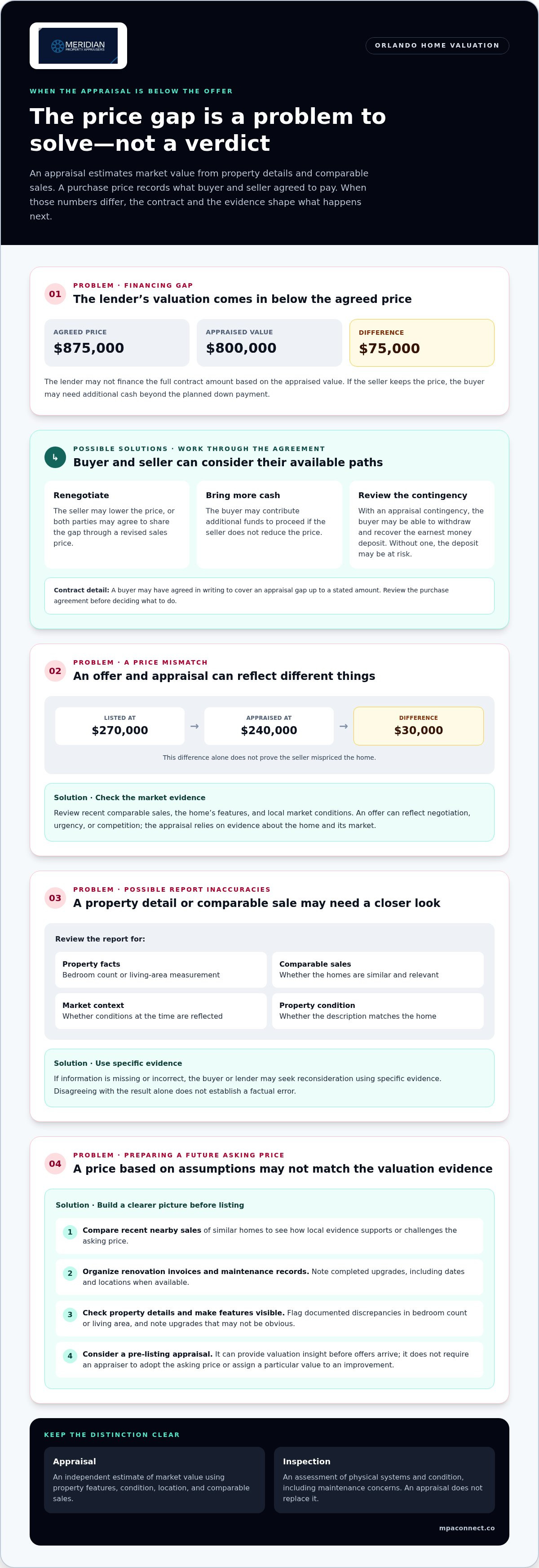
Financing makes the distinction consequential. A lender uses the appraisal to assess the property against the loan amount, so a lower valuation can leave the buyer responsible for a gap. For example, if the agreed purchase price is $875,000 and the home appraises at $800,000, the difference is $75,000. If the seller won’t reduce the sales price, the buyer may need that additional cash beyond the planned down payment.
A separate illustration shows how the gap arises: a home listed at $270,000 that appraises at $240,000 has a $30,000 difference. That doesn’t automatically mean the seller mispriced the property. The offer may reflect a buyer’s personal valuation, while the appraisal relies on market evidence. Local housing market conditions, the selected comparable sales, and the home’s features can all affect the result.
Before responding, buyers and sellers can review the appraisal report and purchase agreement. Check whether the report describes the property accurately and whether its comparable sales reflect similar homes and relevant market conditions. If information is missing or incorrect, the buyer or lender may seek reconsideration using specific evidence. Disagreement with the result alone doesn’t establish a factual error.
Renegotiation gives both parties a way to decide whether the sale can proceed. The seller may lower the price, the buyer may bring more cash, or they may agree to share the gap through a revised sales price. A buyer might also have agreed in writing to cover an appraisal gap up to a stated amount. For instance, an offer of $415,000 on a home asking $400,000 could include a promise to cover a gap of up to $15,000.
An appraisal contingency can affect the buyer’s options. If the purchase agreement includes one, the buyer may be able to withdraw and recover the earnest money deposit. Without that protection, leaving the transaction may put the deposit at risk or prompt a seller dispute. Cash buyers aren’t relying on lender financing, but they still need to decide whether the appraisal evidence supports the agreed amount.
For sellers planning a future listing, a Pre-Listing Appraisal can provide valuation insight before offers arrive. That early perspective can help frame an asking price around property details and market evidence, rather than assuming every buyer’s offer will match the eventual appraisal.
3. Appraisals and their role in setting an Orlando asking price
An appraisal can help an Orlando seller set a defensible asking price before listing. It provides a formal estimate based on the property and market evidence, rather than the seller’s preferred figure alone. Use it alongside recent comparable sales and the home’s condition. The goal isn’t to guarantee that every buyer or lender will reach the same value, but to make pricing decisions more informed.
A pre-listing appraisal can be especially useful when a home has unusual features, extensive renovations, or few similar nearby sales. Review the report’s comparable properties and adjustments for differences. For example, if a sale involves a larger lot or a different layout, consider how that affects its relevance to your home. A well-supported asking price connects the property’s details to market evidence.
Use the report as a planning tool. First, check that it describes the home accurately, including its bedroom count and gross living area. Next, gather renovation or maintenance records that could help explain the property’s condition. Then compare the valuation with available sales of similar homes in the neighborhood. This process can help you determine whether the asking price reflects supportable features or relies on expectations the market may not share.
An Orlando seller can share an appraisal report with prospective buyers as supporting information. Explain when the report was prepared and its purpose, because a pre-listing valuation and a lender-ordered appraisal may serve different needs. Buyers can consider the report alongside their offer and financing arrangements, but it doesn’t require a lender to approve a particular mortgage amount.
Once a purchase agreement is signed, the appraisal may affect the transaction in a different way. A lender uses it to assess the property in relation to the loan and generally bases the mortgage on the purchase price rather than a higher appraised value. If the report identifies factual errors, such as an incorrect living-area measurement, the seller can raise the specific issue through the buyer’s lender’s correction process. Evidence is more useful than a general objection to the conclusion.
If the appraisal supports the asking price, the seller can present relevant report findings and property records during negotiations. If it falls below the planned price, revisit the comparable sales, the report’s factual details, and any appraisal contingency before deciding what to do. A written agreement may include a special condition allowing a price change, but a seller usually can’t raise the price after signing solely because the appraisal came in higher. The contract’s wording shapes the available choices.
4. Factors appraisers consider
An appraiser estimates market value by examining the home, its location, and relevant sales. In Orlando, recent neighborhood activity helps place a property in its local market. The appraiser also considers property size, layout, lot size, condition, upgrades, and current market conditions. No single feature automatically determines appraised value; the report weighs the home’s characteristics against the available evidence.
Comparable sales help show what buyers have paid for similar properties. Appraisers generally report at least three comparable sales, then account for meaningful differences between those homes and the property being appraised. A smaller home or different layout may provide less useful comparison than a nearby property with similar features. Sale dates and neighborhood relevance matter because market conditions can change over time.
How recent should comparable sales be for an Orlando home appraisal? The appraiser considers recent sales that best match the property and reflect current local conditions. There isn’t a single time cutoff in the available guidance; a sale’s usefulness depends on its similarity and whether market changes make it less representative.
Physical details also shape the analysis. Gross living area means above-grade living area, excluding garages and basements. A garage may still be noted as a property feature, but it isn’t included in that measurement. Sellers can help avoid factual confusion by reviewing the property description and gathering records of documented renovations or maintenance.
Do Orlando neighborhoods, school zones, or HOA features affect appraisal value? Location and community features can influence the assessment, so neighborhood context matters. A school zone or HOA amenity may help describe that context, but its relevance depends on how it relates to comparable properties and local market evidence.
For a condominium, the appraiser assesses both the individual unit and the condo project as a whole. The unit’s layout and condition matter, while the broader project provides additional context for comparison. For a detached Orlando home, lot size, nearby comparable properties, and neighborhood conditions help show how the property fits its market.
Proximity to local destinations can also shape location analysis. In Orlando, proximity to attractions such as Disney or Universal Studios can influence value. Distance alone does not set the price; the appraiser considers location alongside the home’s features and comparable sales.
Before selling, organize renovation records, confirm property details, and note features that may not be obvious during a visit. A real estate agent’s pricing opinion may help guide a listing, but it differs from the appraiser’s formal analysis. If the report contains a factual error, identify the exact item and provide supporting evidence. A difference between an offer and the appraised value does not, by itself, show that either figure is wrong. The contract and any appraisal contingency shape the parties’ next steps, including whether a buyer can walk away.
5. How do recent Orlando comparable sales support a home's asking price?
Comparable sales, or “comps,” show what buyers paid for homes resembling the property being valued. In Orlando, appraisers consider recent sales, local market trends, and community features to estimate market value. For sellers, relevant comps can help explain why an asking price fits the area. They’re most useful when they resemble the home in location, size, layout, condition, and features.
Start by grouping sales from the same neighborhood or a nearby area with similar characteristics. A home in one Orlando community may not be a sound comparison for a property elsewhere if location, access, or community features differ. Then compare the properties themselves. A similar floor plan and lot can offer stronger context than a home that shares only the same general area.
Look beyond a comp’s headline sale price. Compare its living area, layout, lot, condition, and renovations with the home you’re pricing. For example, a renovated property may support a higher asking price than a similar home needing substantial updates. But the difference should be grounded in the properties’ actual features and market evidence, not simply the seller’s renovation costs or preferred return.
Recent sales also help reveal local market direction. If comparable Orlando homes sold for less than the seller’s planned asking price, that evidence may prompt a review of the price or its supporting details. If sales align with the target, the seller can point to those examples when explaining the asking price. Appraisers also consider market trends, so older transactions may tell a different story from current neighborhood activity.
To prepare a useful comparison, organize the evidence before setting or defending the price. Identify the home’s key characteristics, then note how each selected sale matches or differs. Keep the explanation specific: “similar layout, but smaller lot” is more useful than calling a property “nearly identical.” This clear comparison helps buyers understand the reasoning and gives the appraiser relevant context to assess.
A real estate agent may prepare a comparative market analysis to guide pricing or offers. That informal estimate can help sellers review local sales, while a formal appraisal provides a separate valuation. If a buyer challenges the asking price using nearby sales, compare those properties with the home’s condition, location, and features before negotiating. The strongest response addresses the actual differences rather than dismissing the buyer’s examples.
Use comparable sales as evidence, not as a promise that a lender’s appraisal will match the asking price. For a property-specific valuation that can inform pricing, request appraisal guidance for your Orlando home.
Meridian Property Appraisers Inc.: Pre-Probate Inherited Properties Appraisal
Meridian Property Appraisers Inc. provides a Pre-Probate Inherited Properties Appraisal for people assessing an inherited home before probate. If you’re preparing to sell, a Pre-Listing Appraisal can inform your asking price. A documented valuation helps you consider the property’s features and market evidence as you plan your next step.
Choose an appraisal suited to your situation, whether you’re assessing an inherited property before probate or preparing a home for listing. For an inherited property or an upcoming sale, contact Meridian Property Appraisers Inc. to discuss your appraisal needs.
Set your next move with a clear valuation
Before setting or revising an asking price, decide what you need the valuation to help you do. You may be preparing to list, responding to a buyer’s concern, or documenting a property’s value during a major life change. A clear purpose helps keep the appraisal useful beyond a single negotiation.
For sellers, justifying an asking price with an appraisal in Orlando can provide a measured starting point for conversations with prospective buyers. Use the report as part of your decision-making, alongside the property’s current condition and sales evidence relevant to your home. If the market response differs from your expectations, revisit your pricing strategy with the facts in view.
Meridian Property Appraisers Inc. offers appraisals for inherited properties before probate, pre-listing decisions, and divorce-related valuation needs. If a property valuation is your next step, contact Meridian Property Appraisers Inc. to discuss your situation. A thoughtful plan can help you approach the next decision with greater clarity and confidence.
Frequently Asked Questions
What happens if the appraisal is lower than the offer?
If the appraisal is below the offer, the lender bases financing on the appraised value, leaving a shortfall against the agreed purchase price. The parties can renegotiate, the buyer can bring additional funds, or the buyer may use an appraisal contingency if the contract provides one. Before deciding, compare available funds, revised terms, and contingency language, then follow the steps set out in the purchase agreement.
What is a home appraisal?
A home appraisal is a formal estimate of a property’s market value, based on the home and relevant market evidence. It gives buyers, sellers, and lenders a valuation for a specific purpose, such as supporting a financed purchase. It isn’t a home inspection, which focuses on physical condition, or a real estate agent’s comparative market analysis, which is an informal pricing estimate.
What can be done about a low appraisal?
Start by reading the report for incorrect property details, missing improvements, or comparable sales that don’t represent the home well. Gather relevant records, such as renovation documentation, and identify each discrepancy clearly. A buyer or lender can ask for reconsideration when there’s evidence of missing or incorrect information. The request should address specific report details, not simply state that the value seems too low.
What do appraisers look for?
Appraisers examine the property’s features, condition, location, lot, and layout, then compare it with relevant sales and market conditions. For a condominium, the review includes the unit and the condo project. A seller can clarify details by organizing upgrade records and confirming property facts, such as bedroom count. A garage is not included in gross living area, which refers to above-grade living space.
How do Orlando home sellers use an appraisal to justify their asking price?
Sellers can use an appraisal to explain how the home’s features and market evidence support a proposed price. Justifying an asking price with an appraisal in Orlando means sharing relevant report details alongside upgrade records and comparable sales. Keep the explanation specific: connect each pricing consideration to the property or local evidence. This can support a more informed discussion with prospective buyers.
What factors do Orlando appraisers consider when valuing a home?
Orlando appraisers weigh comparable sales, property size and layout, condition, location, lot size, upgrades, and market conditions. Community context can matter too, including proximity to destinations such as Disney or Universal Studios. The influence of any feature depends on how it relates to the property and market evidence. Accurate property details and organized improvement records help sellers understand the report’s analysis.
What is the difference between a seller's appraisal and a buyer's lender appraisal in Florida?
A seller may obtain an appraisal before listing to inform pricing, while a buyer’s lender generally orders one after the purchase agreement to assess the property for financing. The intended use differs: the seller wants valuation guidance before marketing, while the lender needs an assessment tied to the proposed loan. The reports may rely on similar property and sales evidence, but one doesn’t guarantee the other’s result.
How can sellers challenge or dispute a low appraisal in Orlando?
First, identify a factual issue in the report, such as an incorrect bedroom count, living-area figure, or overlooked improvement. Gather records supporting the correction, then contact the buyer’s lender about its process rather than contacting the appraiser directly. A buyer or lender may request reconsideration when evidence shows missing or inaccurate information. A different opinion of value, without supporting facts, is not the same as documenting an error.



Comments