
What to Do if Your Home Appraisal Is Low in Florida
A low appraisal changes the financing math, but it doesn’t automatically end a Florida home purchase. If you’re deciding what to do if your home appraisal is low in Florida, start with this: the lender bases its loan on the appraised value, not the agreed price. You may need to cover the difference with cash, negotiate new terms with the seller, or rely on a contract contingency if one applies.
It’s understandable to feel unsettled when the appraisal comes in below your offer. The difference can change how much cash you need at closing, but you have practical steps to consider before deciding whether to proceed.
This guide explains what a low appraisal means for your offer, who can request a Reconsideration of Value, and how to support that request with relevant evidence. It also covers negotiating the gap, checking contract deadlines, and understanding the effect on your financing so you can make an informed decision.
Table of Contents
1. What happens if the appraisal is lower than the offer?
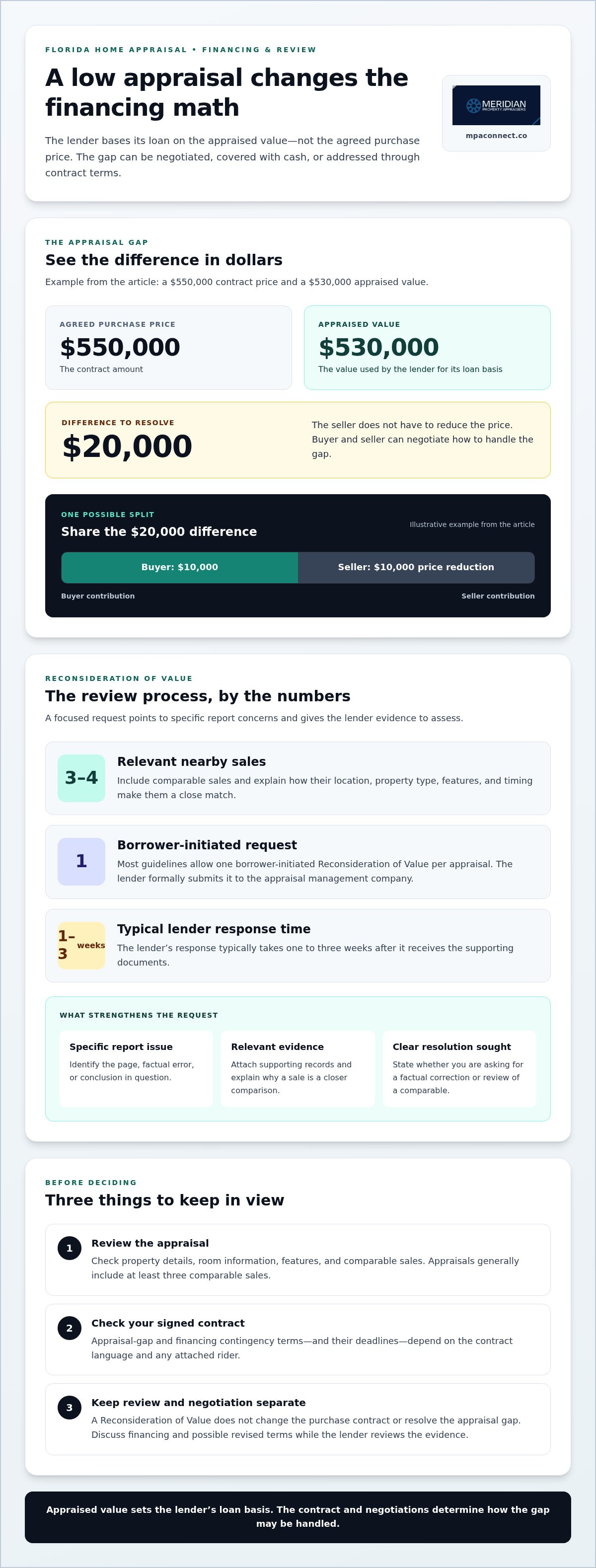
A low appraisal leaves a difference between the agreed purchase price and the home’s appraised value. The lender bases its loan amount on the appraised value, not the higher contract price, so your original financing plan may no longer cover the purchase as expected.
The seller doesn’t have to lower the purchase price because the appraisal came in low. The buyer and seller can negotiate, though, and the final choice depends on what each is willing to accept. A buyer might offer to bring more cash, ask the seller to reduce the price, or propose sharing the difference. For instance, with a $550,000 contract price and a $530,000 appraisal, one possible split is $10,000 from the buyer and a $10,000 price reduction from the seller.
Before negotiating, compare the appraisal report with the property and your contract. Appraisals generally include at least three comparable sales. A sale is more useful when its location, property type, features, and timing closely match the home being appraised. In Florida, comparable sales may be from several months before the appraisal, so a recent shift in local market conditions may help explain the difference between the offer and appraised value.
Waterfront and custom homes can be difficult to compare when nearby sales don’t closely match their location, property type, or features. A standard home nearby may not be a close comparison for a property with distinctive design or waterfront features. When reviewing the report, look for sales that reflect the home’s specific characteristics.
A low appraisal can also result from an inaccurate property detail or a poor match among the selected sales. Check the reported living area, room details, and features against the home. Gross living area refers to above-grade living space, excludes garages and basements, and is measured using exterior building dimensions for each floor. Errors in these details can affect the comparison.
For a focused negotiation, state the difference, identify the report detail or comparable sale in question, and make a specific proposal. Sellers may weigh your offer against their alternatives and how long the home has been listed. A seller whose home has been listed for several months may be more open to sharing the gap than one who listed the previous week. Keep the discussion centered on appraisal evidence, a revised purchase price, and each party’s proposed contribution.
2. Who can request a Reconsideration of Value on a low appraisal?
In Florida, the lender formally submits a Reconsideration of Value to the appraisal management company. As the buyer, you can ask your lender to submit one and provide evidence for the request. The appraiser reviews the concerns through the lender’s process.
Build the request around specific issues in the report, not simply disagreement with the contract price. Check the property details, comparable sales, and conclusions. If a sale seems more relevant than one in the report, identify it and explain how its location, property type, features, and sale timing make it a closer match.
Organize the evidence so the lender can assess it clearly. Include three to four relevant nearby sales, and identify the report page or property detail related to each concern. Attach supporting documents, such as records that clarify an inaccurate property feature. State the resolution you’re seeking, such as correcting a factual error or reviewing a particular comparable.
Keep the request factual. Pointing to a specific mistake gives the reviewer something concrete to evaluate. Saying only that the value seems low doesn’t explain what the appraisal may have missed. The lender may decline to seek another appraisal if the request lacks clear, compelling evidence of an oversight.
Most guidelines allow one borrower-initiated Reconsideration of Value per appraisal, so a complete first submission matters. Before sending it, make sure the sales are genuinely comparable, the supporting details are easy to follow, and each concern connects to a specific report entry. A lender’s response typically takes one to three weeks after it receives the supporting documents.
A second appraisal is a separate possibility, not an automatic result of requesting a review. It may be approved if the Reconsideration of Value identifies a deficient appraisal or material errors that the original appraiser refuses to correct. Focus first on documenting the deficiency. Simply asking for another opinion doesn’t establish one.
A review won’t change the purchase contract or resolve the appraisal gap. Keep the contract price, financing discussions, and any action deadlines in view while the lender considers the request. If your deposit is at stake, understand how the signed contract addresses cancellation and earnest money. You may need to renegotiate with the seller, but an appraisal challenge and a contract negotiation are separate processes.
3. What can I do if appraisal came in low?
In Florida, an appraisal-gap clause describes how the buyer and seller will handle an appraised value below the agreed purchase price. A financing contingency addresses financing-related cancellation rights. The signed contract and its deadlines determine how those protections apply.
Start by locating the appraisal and financing terms in your signed purchase agreement and any attached rider. Check the terms of your signed contract before assuming that a low appraisal lets you walk away. Read the exact language, including any notice or document requirements.
Comprehensive Rider F has a specific delivery requirement: the buyer must provide the seller with a copy of a low appraisal within three days. Read the rider’s full terms and identify the relevant deadline as soon as the appraisal arrives. Missing a required notice period can affect the options the contract provides.
If an appraisal contingency applies, it may allow you to cancel if the appraised value is below the contract price and negotiations fail. Follow the agreement’s notice process before cancelling. For example, send the required appraisal copy to the seller by the stated deadline, then document whether both parties agreed to a price adjustment or another resolution.
A financing contingency is different from an appraisal contingency. It addresses whether you can obtain financing under the contract’s terms. If the lender can’t approve the loan because the appraisal affects the financing, the contingency may provide a path to cancel and recover earnest money, subject to the agreement and its deadlines. Ask the lender to explain the effect on the loan, then compare it with your contract’s financing terms.
Earnest money isn’t automatically protected just because the appraisal is low. If your contract includes a relevant contingency and you follow its notice requirements, you may be able to cancel and recover the deposit. Without an applicable contingency, walking away could put the deposit at risk or lead to a seller’s legal claim. Don’t treat an appraisal objection as a cancellation notice unless the contract says it is.
Before deciding, record the appraisal delivery date, the applicable objection or notice deadline, and the steps the contract requires. Keep copies of your written notice, appraisal, and communications with the seller. If you want to proceed, negotiate a price change or another agreed solution. If you plan to walk away, follow the contract’s cancellation process before the deadline. This helps protect your position while the lender assesses the financing.
4. Covering the appraisal gap with cash
Paying the appraisal gap in cash lets you proceed without asking the seller to reduce the purchase price. The gap is the difference between the contract price and the appraised value. Before committing, calculate how much cash the lender’s loan terms require you to bring to closing.
Consider a $400,000 purchase with an appraisal of $370,000. The appraisal gap is $30,000. With a planned 20% down payment, the buyer expected to contribute $80,000. If the loan is limited to 80% of the appraised value, the maximum mortgage is $296,000. Keeping the $400,000 purchase price would require $104,000 at closing, before other closing costs.
The gap isn’t simply added to a mortgage. The lender calculates the loan using the appraised value and applicable loan-to-value limit. You can cover the difference with additional funds, renegotiate the price, or consider another option allowed by the contract and lender. Paying cash is optional, not an automatic requirement to complete the purchase.
Check the purchase agreement for an appraisal-gap coverage clause. It may specify how much of a shortfall you agree to cover and under what conditions. Compare its limit with your available funds: a commitment to cover the gap could require cash beyond your planned down payment. Don’t assume the clause covers the entire difference unless its wording says so.
Ask the lender to recalculate the cash needed using the appraised value, loan amount, down payment, and any gap commitment. Compare the estimate with the funds available for closing and your remaining reserves. If you can cover the full difference, you may keep the agreed price. You and the seller can also negotiate a lower price or share the gap.
Some mortgage lenders allow gift funds to help cover an appraisal gap. Ask your lender how a gift affects the loan and what documentation it requires. Include the funds in your plan only after the lender has reviewed them.
A buyer with a planned conventional-loan down payment of 20% might consider reducing it to 15% or 10% to free up cash for the gap. That change can require private mortgage insurance until equity reaches 20%. Compare the reduced down payment, possible insurance cost, and total cash to close before choosing this route.
Write down the gap, your available funds, and the revised loan estimate before deciding. If the cash requirement strains your budget, negotiate with the seller before agreeing to cover it. A clear agreement helps both parties understand how the transaction can proceed.
5. How a low appraisal affects mortgage financing and cash to close
For FHA, VA, and conventional loans, the appraisal helps the lender assess the property’s value and determine the loan amount. Working with a knowledgeable mortgage brokerage like Smart Home Loans can help buyers evaluate alternative financing structures when valuation hurdles arise. The specific financing effect depends on the loan’s terms and limits, while your contract determines your rights if the value is below the purchase price. To understand what to do if a home appraisal is low in Florida, start by learning how the lender recalculates its loan using the appraised value.
A low appraisal can reduce the mortgage available for a Florida purchase, leaving more for you to cover at closing. For example, a $500,000 purchase with a 20% down payment plans for a $400,000 loan.
A lower appraised value changes the cash calculation. Rework your estimate using the appraised value, the lender’s maximum loan amount, your down payment, and other closing costs. Ask the lender for an updated cash-to-close figure before deciding whether to contribute more, renegotiate the purchase price, or consider another option allowed by your contract.
You can’t simply add the appraisal gap to the primary mortgage if that would exceed the applicable loan-to-value limit. You may use available cash, adjust your planned down payment, or negotiate with the seller. A lower down payment can affect mortgage insurance requirements, so compare the revised payment and cash needs before changing your financing plan.
Review the appraisal report and financing terms together. If the report contains a factual error or overlooks relevant comparable sales, submit a focused reconsideration request through the lender. Identify the report detail, attach supporting information, and state the correction or review sought. Until the lender updates its decision, plan around the current appraisal when assessing your financing.
Deadlines matter. Check your signed contract for appraisal objection, financing, and cancellation dates, then record each alongside the lender’s updated loan estimate. If a contingency applies, follow its notice procedure before the deadline. This keeps a financing decision separate from an appraisal challenge and clarifies any earnest money protections in the agreement.
If you’re deciding what to do if a home appraisal is low in Florida, compare three figures: the contract price, the appraised value, and the lender’s revised loan amount. Calculate the remaining cash needed and decide whether it fits your budget. If it doesn’t, raise the issue with the seller promptly and discuss the specific loan effects with the lender before closing.
Meridian Property Appraisers Inc.: Pre-Probate Inherited Properties Appraisal
Meridian Property Appraisers Inc. provides Pre-Probate Inherited Properties Appraisals for inherited homes that need a valuation before probate. This can help establish a documented view of the property’s value for estate-related decisions. It serves a different purpose from asking a lender to reconsider a purchase appraisal.
If you’re preparing to list a home, a Pre-Listing Appraisal can provide a valuation before you set an asking price. A Divorce Appraisal or FEMA Appraisal may fit other property-related needs. Choosing an appraisal for your situation helps focus the report on its intended use.
For an inherited property valuation, contact Meridian Property Appraisers Inc. to discuss the Pre-Probate Inherited Properties Appraisal.
Move Forward With a Clear Property Valuation Plan
Before taking your next step, put your decision in writing. Note the outcome you need, the documents that support it, and the contract or financing steps still required. This gives you a clear reference for conversations with the lender, seller, or other professionals involved.
Knowing what to do if your home appraisal is low in Florida also means distinguishing a purchase-loan review from a valuation for another purpose. If you’re handling an inherited property, preparing to list, or working through a divorce, a valuation tailored to that situation can support an informed next step. Meridian Property Appraisers Inc. provides appraisals for these needs.
For a measured conversation about your property appraisal, contact Meridian Property Appraisers Inc. Bring the property details and explain how you plan to use the valuation. A clear purpose helps focus the discussion. Take the next step with care and confidence.
Frequently Asked Questions
What happens if the appraisal is lower than the offer?
A lender’s valuation can reduce the mortgage available for your purchase, so recalculate your cash needs before deciding. Ask the lender for a revised loan estimate showing the approved amount and expected funds due at closing. Compare that figure with your budget and contract deadlines. If the numbers don’t work, promptly discuss a price change or another agreed solution with the seller.
Does Florida's standard contract protect me if the appraisal comes in low?
Florida’s standard FAR/BAR contract doesn’t include a standalone appraisal contingency. Your protection depends on the exact contract you signed and any attached rider or addendum. Read the appraisal, financing, and cancellation terms together, then note the notice requirements and deadlines. For example, Comprehensive Rider F requires the buyer to deliver a copy of a low appraisal to the seller within three days.
Who can request a Reconsideration of Value on a low appraisal?
You can ask the lender to submit a Reconsideration of Value, but the lender formally sends it to the appraisal management company. Make the request specific: identify the report detail in question and provide relevant sales or documents to support your concern. A general objection based only on the agreed price gives the reviewer little factual basis to assess. The lender handles the formal submission.
How do buyers and sellers weigh a price or financing gap?
You can compare the lender’s revised loan amount with the cash you can bring to closing, while the seller weighs a proposed change against their sale plans. Start with the appraisal difference and a specific proposal, such as a lower purchase price or shared gap. Relevant comparable sales can support the discussion, especially when they closely match the home’s location, features, and sale timing.
Low Appraisal Options in Florida: Challenge, Renegotiate, or Bridge the Gap?
Choose your next step based on the cause of the shortfall and your financing. If the report contains a factual error or overlooks a strong comparable, ask the lender to submit a Reconsideration of Value with supporting evidence. If the appraisal appears sound, negotiate the price or terms with the seller. Bringing cash can bridge the difference, but first calculate the revised loan and closing funds required.
Should I pay the appraisal gap as a buyer?
Pay the gap only after comparing the additional cash required with your available funds, loan terms, and remaining budget. The lender bases the mortgage on the appraised value, so paying more doesn’t automatically increase the loan. Review any appraisal-gap clause before agreeing to cover a shortfall, and ask the lender how your planned down payment and loan-to-value limit affect cash to close.
What can I do if appraisal came in low?
Check the report for incorrect property details, then gather relevant comparable sales if the valuation appears unsupported. Ask the lender about submitting a Reconsideration of Value, and review your signed agreement for appraisal or financing terms and deadlines. At the same time, calculate the cash needed under the lender’s current loan estimate. This gives you a practical basis for discussing price or next steps.
What can be done about a low appraisal?
You can provide evidence for a lender-submitted review, negotiate a different purchase price, or use available cash to cover some or all of the gap. The seller may agree to revised terms but isn’t required to reduce the price. If you can’t reach an agreement, follow the cancellation and notice terms in the signed contract rather than assuming the appraisal alone ends the transaction.


Comments